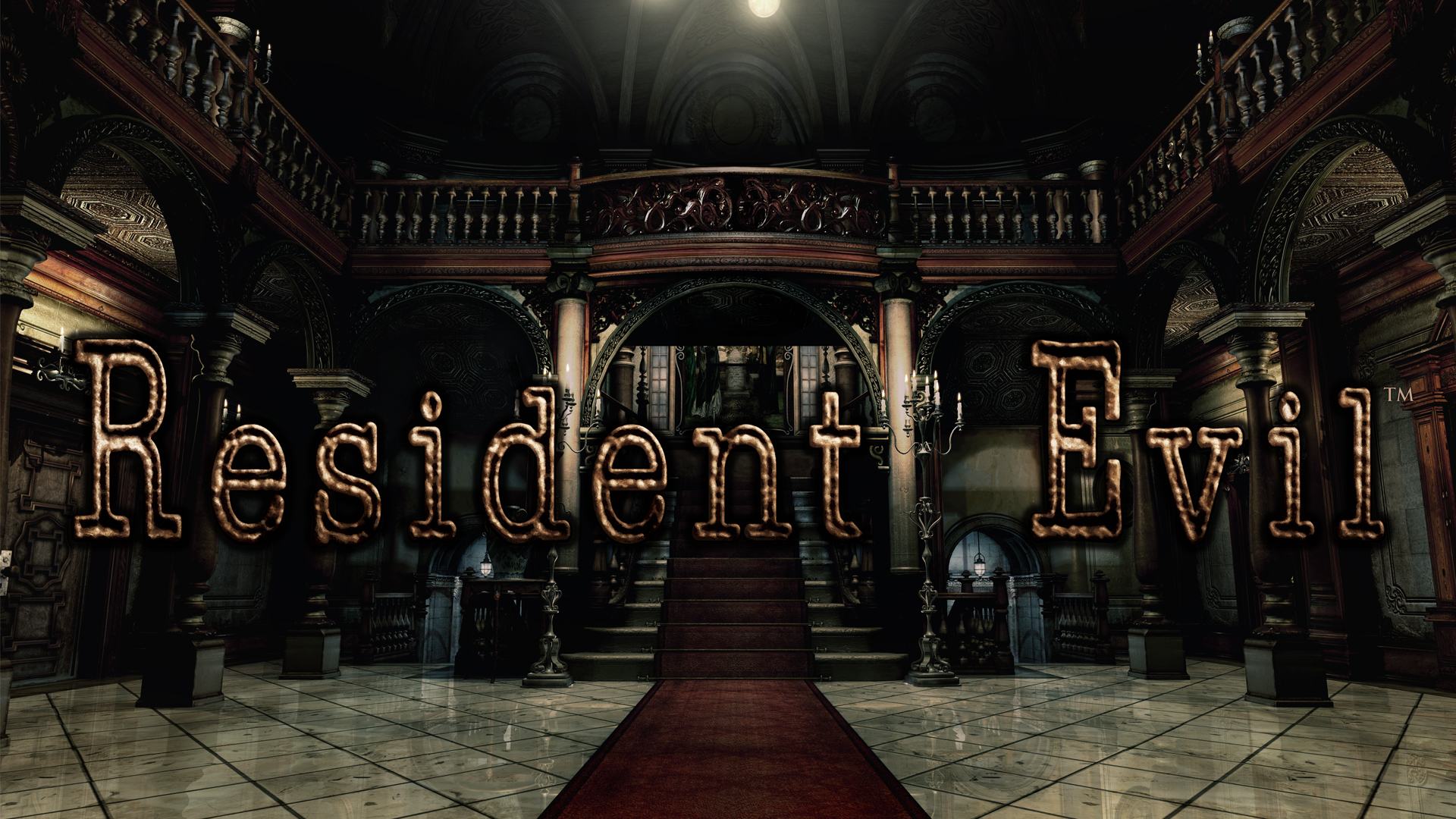
The series has, once again, been brought back to life for current gen
consoles with enhanced graphics, updated
controls, and bonuses not featured in the previous GameCube and Wii
versions.
GRAPHICS: 720p running at 30 frames per second (HUGE improvement! Every
detail of the mansion's paintings, furniture, statues, and creatures are
now more noticeable. You can even SEE the partially faded iris and
pupil of the zombie that killed Kenneth when it turns it's head and
notices you. Items look even more detailed, colorful and vivid when
examined as well...). Lisa Trevor's appearance is even more FRIGHTENING.
She and the "Afflicted" from the upcoming "Revelations 2" have quite an
apparent thing in common...
SOUND AND MUSIC: 5.1 surround sound (Hardly any difference compared to
the original, although some soundtracks were slightly changed, such as:
"Unclean Kitchen", "Residence", "Return to the Mansion" and "Lab
entrance") Frankly, I don't really like what they did with both the
"Residence" and "Lab entrance" tracks since they no longer sound nearly
as great or intense as they did when you compare to how they sounded in
the original GameCube/Wii versions.
CONTROLS: For fans who never played this Remake or any of the
original RE games on the old consoles with the so-called old "Tank
Controls" like old core fans (like myself) did, there's an option that
will allow you to switch the controls to the more modern styles like in
the more recent RE titles for your own convenience. You can "Aim" and
"Shoot" with "L1" and "R1" instead of "R1" and "X". And these new
updated control settings will allow you to command Jill and Chris
(should you need to make quick escape from a B.O.W. or trap) to make a
more easy 180 degree turn with just the analog stick by simply moving it
backwards instead of having you (the player) make that extra effort to
pressing those button combos "Down" and "A" or "X" (for actions) to make
those quick turns to get away from danger. I still personally prefer
the old "Tank Controls" for this RE title because of the camera
settings, and since you also have to get use to having to constantly
keep switching the analog stick's direction more often for your
character's movement when walking or running around the mansion and the
view changes.
I enjoyed playing RE ever since it's release back in 2002
(and still do) and I consider it one of Shinji Mikami's (the creator) masterpieces in gaming history for the Resident Evil franchise.
And this new version feels so much more fresh to look at with it's
improved HD quality and newly added features for more game-play
enjoyment.
In a lot of horror games, especially ones with combat, you start with a
"stealth" approach but once discovered can start firing off rounds and
be fine in the end. Not here. The Evil Within is not only terrifying
and grotesque, but it hits fantastic notes of survival and knowing when
to fight and when to run.I would describe this game as a throw
back to Resident Evil 4 but with updated controls and aesthetics. To
me, it plays like a cross between RE4 and The Last of Us.
Gameplay: The game consists of moving through various locations as you
locate people and move the story forward. It starts out with a bang,
and if you've watched any of the game videos, the first level will look
familiar. You choose to play on Casual Mode (for weaklings as the game
describes) or Survival (the normal difficulty setting).For one, you can't see as much, meaning it will be easier
for an enemy to sneak up on you. Luckily, they make awful noises that
will alert you to if someone (or something) is near. While crouched in
stealth, if you sneak up on an enemy you can instantly kill them. You
can also find goodies like bottles to pick up and use to distract
enemies. Also, if you have one in hand and they're coming for you,
throw and hit them with it for a short window to stealth kill them. But
what happens if they turn around during your approach?
Running
is always an option. You have the choice between fight or flight, but
with scarce resources, flight is usually the better course of valor.
Sebastian, our valiant detective, has a varied arsenal of weapons and
tools at his disposal to deal with the nightmarish fiends he will
encounter. You will acquire (or rather re-acquire) your revolver and
early on will also find a shotgun and crossbow (dubbed the Agony
Crossbow). Holding down shoot with the
crossbow will change it's trajectory for a straighter shot. Since sound
matters, using any guns (or even sprinting/walking) will clue enemies
in to where you are. The crossbow is essentially silent meaning you can
take down enemies in any way you see fit. Sebastian is also a smoker and
though he's run out of cigarettes, he will still find an extremely
useful purpose for matches - burning bodies. And unfortunately for
Sebastian, not every body lying on the floor is dead. Throwing a match
and burning them will alleviate any worry about them coming back. Of
course, if you find yourself low on ammo and matches with no other
recourse, running is always an option. The enemies aren't the quickest
(or smartest) so you can get out of their field of view and hide in
various locations. I've successfully hid in lockers, armories, under
beds... I've also been located in these locations as well, so it's not
always fool proof.
Early on Sebastian discovers some strange location where
he wakes up in a hospital bed. Lucky for him, this is a safe place -
probably the only safe place left. In this area, you can save, later
unlock boxes for goodies and resources, and upgrade Sebastian's
abilities, stock, etc. You will take that healthy looking green gel and
inject it straight into his brain! Jars will typically yield
200-500... gel... bits... and after hording enough you can upgrade.
Some upgrades are cheap, starting at 500, while others are more
expensive - such as unlocking better health starting ~3000. All of
these get more expensive for each level you unlock, up to level 5. To
gain access to the save location, you'll have to locate mirrors that are
broken and glowing.
The gameplay isn't perfect, and I've had
some moments of frustration. There is a checkpoint system in place in
case you die (which you will) but it means if you slip up after making
it almost to the next location and die, any items, gel, collectibles
you've found will have to be acquired again. It's punishing and
frustrating at times, especially when you're trying to peek around the
corner and think all is well only to discover nope, you're now dead.
Also, there is plenty of trial and error. I've discovered that while
going for the head is the norm with bullets, it's not as useful here -
especially when they're missing over half of their head. I found
hitting them in the leg and then burning them is efficient, but it does
cost a bullet and a match. Also, enemies may pop up again if not burned
and it can be extremely annoying, especially in tight locations where
it's nearly impossible to run around them.
Controls: The
controls are very responsive and laid out well. Aiming, shooting,
melee, sneaking, sprinting are all easy to perform. You can not shoot
from the hip; you will have to manually aim and fire (though you can
move while doing so). I haven't explored any alternative control
schemes, but by default crouching requires the button to be held
(instead of a tap to switch between). I prefer it the other way, but it
hasn't affected my enjoyment at all. Opening up inventory slows the
game down so you can quickly switch weapons. Also, don't forget to put
your items into the d-pad "quick slot" for easy and fast access. One
gripe I do have is contextual actions can
sometimes be hidden by the camera, just high enough above what we can
see to not actually see it. I like not being reminded I need to press to open a door, except when things get hairy and I forget which
button opens up a door (or if the door can even be opened).
Graphics:
The graphics look great, but have a throwback feel to them. The game
is set with a graininess (can be adjusted in options) to harken back to
old horror movies. Sebastian and the enemies models are fantastic, with
a lot of detail and gore on the bad guys. After shooting a crazed
chainsaw man in the leg several times, I noticed that his pant legs had
holes in them and after awhile were soaked with blood. The environments
are really well done too, with stone, wood, windows, tile, lights all
looking great. Some of the other character models don't look as nice
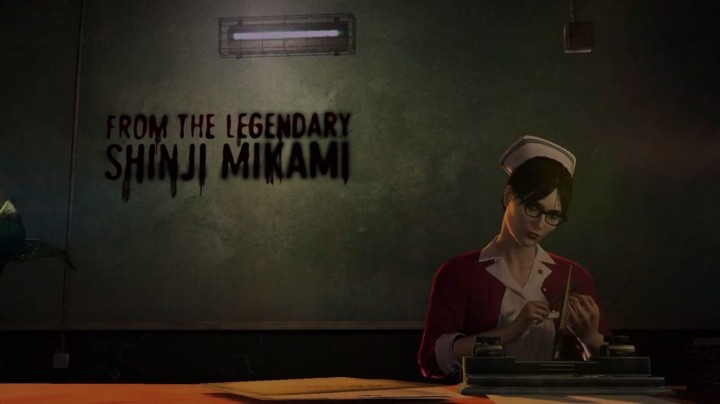
(the nurse you meet looks like she was plucked from Silent Hill 2).
Some of the animation are a little stiff (swinging lights come to mind
in a few instances as well as mouth movement on characters), but the
vast majority are fantastic and fluid.
Sound: Lightning crashes,
rain pattering down, explosions, moans, struggling, chainsaws, screams,
and gunshots all sound top notch. The music does not ever overshadow
the gameplay and works well to convey the mood, though there are plenty
of long stretches of no music, which helps to listen and locate enemies.
Some of the voice acting is campy, and I believe this was done
intentionally as a throwback to earlier survival horror titles like
Resident Evil (which I can guarantee earned no awards for script or
story). The squishing and sloshing is disturbing. What I really
appreciate is that this game relies on tense harrowing encounters to
instill fear rather than cheap jump scares. I was often cautious about
entering a location, but never afraid of having a heart attack as an
enemy jumps out with a shrill note played at 250% volume.
Story:
It's Shinji Mikami, and the story is absurdly delightful. The police
enter a mental institution, bad things happens. People were
experimented on and some crazy sewn up killer is trying to murder
everyone. There are different horror genres thrown in as well, such as
the crazy chainsaw stalker coming after the helpless lead, slow moving
zombies wanting nothing more to eat you, crazy demon lady thing rising
up from hell out of a pool of blood... I like the pace and the subtle
nuances of different enemies. Of course, if you've never seen an enemy
before and don't know a weakness, running is always an option...
I want to first say that this is not your Lara Croft of the past. This
game has gone a totally different direction than the rest of the
franchise. You shouldn’t go into this thinking it is going to be the
lone-survivor type role of the past.
Temple of Osiris is
definitely geared towards co-op, but allows for more “friendly fire”, if
you will, then most co-ops. You have the ability to hurt you teammates
in quite a few ways, from pushing them off the edge of a mountain with
your shield, to a well-timed spiking. This can make for some funny
moments with your friends, but can get old pretty quickly if your other
teammates are in the mood to complete the actual tasks at hand. At the
end of the level, you're awarded points based on how well you did, which
can then be used to unlock rewards. That means that while you are
working together for one common goal you are also once again pinned
against each other.
One problem I did find, (one not uncommon for
co-op) since the game is all about playing with your buddies I found it
a little boring to play on my own. I got almost a super smash brothers
feel to it. However, there is the option to fill in those extra spots with
online multiplayer.
The graphics aren’t bad but I wouldn’t pin them up in
the same category as the new Diablo (I use the comparison because the
size of the players and levels are comparable on your screen). Though I
do get a similar menu feel as Diablo and the levels seems to have that
sorta dark, creepy overshadow that you see in Diablo.
Overall I
had a blast playing this with my friends. There was a big reason for
this though and that is because I went in thinking about this game in a
new light. I went in knowing that it was not the old Lara Croft. It’s kind of like if you went into the first Bond
movie where Daniel Craig took over from Pierce Brosnon. The movie just
had a total different feel and if you were expecting Brosnon you were
going to be disappointed. Osiris is not a game changer, but for the
cheap price I would say a great pickup to hack around with your friends.
South Park the Stick of Truth follows the New Kid, who moves to the quiet little mountain town under
mysterious pretenses, and quickly falls into a raging battle between
elves and the noble warriors of the Kingdom of Kupa Keep (KKK... yes,
they call themselves that.) The epic struggle is over the titular Stick
of Truth, the owner of which can control the universe. Well... not
really. See, the kids of South Park are engaged in a town-wide LARPing
session, complete with leveling, custom weapons, armor, classes, and the
like. This puts an interesting spin on the show's universe, as everyday
locales like the school or Jimbo's Guns become dungeons or supply
stores. And instead of going all "Calvin and Hobbes," the writers wisely
chose to make it perfectly clear that these are little kids pretending
to be in a role-playing game, and decided to build off that concept.
The result is one of the more clever video games in recent memory.
Narrative tropes, worn gameplay mechanics and other aspects of
role-playing games are put on display and mocked here. When learning the
turn-based battle system, a character questions why they have to wait
their turns, only for Cartman to bark that it's "like olden times."
Naming your custom character is irrelevant because you'll end up going
by "D*uchebag" for the majority of the game. Other things of this nature
help solidify this is as a tongue-in-cheek parody of the genre,
complete with visual and verbal cues to famous series. As a functional,
funny parody of an established type of game, it's a rollicking success.
On top of that, it's "South Park" at its absolute finest. Beneath the
clever satire, we have Matt Stone and Trey Parker's signature blend of
shock humor and gross-out gags. Only this time, it's a lot funnier than
many recent episodes of the show itself have been, as it feels less
constrained by time and censorship, and more like a creative burst of
lovably vile, gut-busting energy. Before playing this game, I would have
laughed in disbelief at the concept of beating up meth heads for coffee
ingredients, or using different types of farts to solve puzzles, but lo
and behold, these are both things that you'll end up doing in game.
Admittedly, some jokes wear thin after a while, and as is the nature of
licensed games, hearing certain characters repeat lines in different
circumstances makes them lose some of their luster. As a whole, though,
this is still a very funny and fresh experience.
And yes, despite the copious amounts of "South Park" fan service,
clever satire, and rip-roaring gags, this is still a game. Actually,
it's quite a good one, and I say this as an avid fan of RPGs. The
turn-based combat is only tight and fun (if not a bit easy,) and holds a
surprising amount of depth to it. Aside from wailing on opponents with a
variety of humorous weapons, you'll also have to learn how to break
down enemy armor, counter different stances, and handle the buff/debuff
system. Players who are weary of turn-based RPGs might find solace in
the fact that you'll be doing a lot more than clicking commands, as
using attacks often requires a series of button presses or flicks of the
analog sticks. Of course, you won't only be locked in fights for the
entire game, which is where the sizable overworld comes into play. As
the new kid, you and a "Buddy" of your choice can wander around South
Park taking side quests, finding collectibles, and making friends to add
to your Facebook-esque list of pals. There's plenty to do, all around,
and both the combat and exploration aspects of "Stick" are admirable in
their execution.
One's opinion on the graphics and sound in this game will boil down to
how much they like South Park. I feel like it
captures the visual style and musical elements perfectly, right down to
the crude walking animations. The music sounds like a mixture of Western
RPG soundtracks and the typical musical motifs one would expect from
the series, even blending the two occasionally.
It looks like South Park, sounds like South Park, and most
importantly feels like South Park.
To put it bluntly, this isn't intended for general audiences. It’s for
people who like either like South Park, RPGs, or both, and if you
don’t fall into that category, odds are that it isn't for you. Just
because it has a limited audience, however, doesn't make it a bad game
by any stretch of the imagination.And, to go out on a limb, it’s one of the most devilishly original and
fun role-playing games to come along in a few years, albeit a simplistic
one.
Despite some jokes overstaying their welcome, and despite the limited
appeal of the whole package, South Park: The Stick of Truth is quite
the admirable little game. Creative, hilarious, and fun, it’s pretty
much heaven for anybody who likes the show, and even for people who are
only casual viewers. It might not win over any new fans, but considering
that most likely wasn't an intention of Obsidian and South Park
Studios, it’s not really a tragedy.
Story: 4/5 So the game's about Ronan, a detective who gets killed while trying to catch a serial killer named "The Bell Killer." Upon death, Ronan wakes up in ghost form where he can see living people but they can't see him. The exceptions are mediums who can interact with both the living and dead. A teenage girl named Joy is one such medium and she sets out with Ronan to find her missing mother Cassandra, who is also a medium, and may be the Bell Killer's next target. Without spoiling anything, I'll just say that the story's pretty interesting and original (at least for games) and leave it at that. The only thing that kept me from giving the story a 5/5 is that Ronan's dead wife is a mere afterthought in the game, and Ronan shows very little emotion towards her memory at all. In fact, after visiting his wife's grave, he strolls out of the graveyard with his little "swagger-strut-while-smoking-a-cigarette" animation that is used ad nauseum. Shouldn't he be feeling blue after visiting his wife's grave instead of acting like he's too cool to be bothered with things like emotion? The writers missed out on a chance to give this game an emotional side that it lacks. Still an interesting "whodunit" story though.
Immersion: 1/5 This is where the game lost me. So once Ronan wakes up in ghost form, he learns that he can't really interact with the physical world anymore, which is made evident when he tries to punch his killer and his fist goes right through the killer's face. Ronan can also pass through objects like tables, beds and interior walls. Exceptions are exterior walls which he can't pass through (because they were consecrated). Fine, I'm good with all that. But the game breaks it's own continuity several times. For example, Ronan continues chain smoking cigarettes throughout the entire game. Are these "spiritual" cigarettes? Because it's already been established that he can't interact with the physical world anymore. And why would a ghost still have the need to smoke anyway? It makes no sense. And believe me, there might be 30 total seconds of this game where Ronan's not smoking. I understand that the idea was to give Ronan an edgy personality, but the whole smoking thing just doesn't work here. There are also many times when Ronan seems to forget that living beings can't hurt or see him. For example, in cut scenes where he's helping Joy sneak through a police station, he tends to hide behind corners himself, forgetting that the officers can't see him anyway. There's also a scene where he's trying to get close to a stray cat, and he approaches the cat cautiously as if the cat's going to scratch his hand.
Also, Ronan has multiple felonies in his background, so how exactly did he pass his background check to become a cop in the first place? He's also covered in tattoos including his hands and neck. Most police departments would eliminate him as an applicant based on those alone. There's a note that Ronan finds from his dead wife and she mentions that neither she nor Ronan are religious. But in the very next scene, Ronan finds a dead priest and does the Catholic heart cross. Maybe he's just paying respect to the dead priest and his religion, but most people who aren't Catholic aren't going to perform a Catholic ritual. All of these things make it hard to suspend disbelief!
Gameplay: 3/5 This is not an action game, it's a detective game. So given that, you'd think the developers would nail that aspect of the gameplay down. Well, they don't. Essentially what you do is go around a crime scene and try to find all of the clues. When you find one, a button prompt will appear and you'll press the button to affirm the clue. Once all the potential clues are gathered, you press a button to conclude the investigation. At this point, the game will ask you what the 3 most relevant clues are that you gathered. Most of the time this is a pretty easy process of elimination, as the clues that are irrelevant will be obvious. Ultimately this makes the game too easy. There are times, however, that a seemingly relevant clue will be deemed irrelevant by the game. It seems to almost be arbitrary, which ruins any sense of intuition the game wants you to have. I don't want to knock them too much for this, because we're dealing with abstract ideas here and video games are typically binary, so it's hard to blend the two together. I applaud their effort in trying to do something fresh, but it just didn't work as well here as a game of this genre should. Examples of games that do it well are Condemned, Condemned 2 and Silent Hill Shattered Memories. Those games found a way to really make you feel like it was YOU that figured something out, instead of just telling the game what it wants to hear so that you can progress.
Quality: 3/5 The graphics aren't bad, but there's nothing mind blowing about them. The animations are merely passable. You'll see some of the same 3D model of characters used over and over, sometimes in the same room. Possessing citizens of Salem and listening to their thoughts is a unique idea, but once again it kills immersion when 2 people in the same room that look exactly the same happen to have an identical thought going through their head.
Side activities: 2/5 There are a slew of collectibles, and a small handful of side investigations you can complete, but none of them are all that compelling and I found myself ignoring them so I could advance the main storyline instead. Trailer
It was somewhere between riding a flaming unicorn through the underworld and surfing on a jet through hoards of angels and demons that something hit me. Throughout my entire playthrough of Platinum's much-anticipated "Bayonetta 2," there was not an instance in which I felt the game peaked. Most good modern games have a peak moment, a moment where everything works and the experience is a breathless, exhilarating thrill ride. Everything after that, nothing is quite the same. Yeah, the rest of the game is good and all, but it never reaches the crescendo that one moment managed to hit. It's unreasonable to expect that most games would be good throughout the entire thing, though. After all, barely anything can be entirely good, through-and-through, right?
That's what I thought, anyway. But Hideki Kamiya and company have proved that assumption wrong for the first time in many, many a year. There is no downward spiral in "Bayonetta 2," no definitive "this is it moment." That sensation of peaking, of a dramatic climax, begins when the first cutscene appears, and only lets up when the last credit rolls. The whole game is a non-stop thrill ride that constantly trumps itself, what with the ridiculous set pieces, gawdy comedy, flawless controls, fantastic aesthetics... the list goes on. The point is, Nintendo has put out not only put out my top contender for Game of the Year, but perhaps a modern classic as well.
You would be fooled to think that by the plot. Not that it's bad, per se, but like everything else on display here it is a display of utter ridiculousness. Bayonetta's former rival and now bestie Jeanne has her soul dragged to the depths of the underworld, and the titular witch has to go all "Dante's Inferno" and rescue her. But there are complications, like a Yugi Motoh wannabe complete with a pyramid necklace and magical cards, and the fact that both demons and angels are now attacking the stylish witch. Within the first few chapters, everything about the narrative goes completely off the rails (if there were any rails to begin with) in the best ways possible, and the player is just supposed to accept the insanity inherent in the narrative and roll with it.
They'd be behooved to do that, because once you accept Kamiya's unique brand of madness, you're in for a real treat. The narrative might not win any awards or be lauded for its emotional resonance, but boy, it sure is a good time. Part dimension-bending epic, part farce, "Bayonetta 2" is a game that isn't concerned with consistency of tone or tasteful subject matter. Instead, it's a delightful carnival of unfettered violence and sexuality, reveling in its own farcical nature. It's the antithesis to every grim, brooding game with gritty, gruff white dudes spouting generic tough-guy dialogue. Good-natured and earnest in its attempts to stay "over-the-top" at all times, this game is one that I would fervently recommend to anybody looking for one of the most genuine, anti-"big box game" experiences out there.
A lot of this is due, in part, to Bayonetta herself. Some people have some issues with her characterization and portrayal, and I honestly understand that. There are some points of the game in which she's blatantly sexualized, and a post-credits pole dance sequence is a bit on-the-nose and lacking the fun punch of the dance sequence in the last game. "Good" objectification is still objectification, and it should be acknowledged. But do I feel like this is a harmful depiction of a woman? No. Not in a million years. Bayonetta is actually one of the most fiercely independent, in-control leading ladies in gaming, and that sentiment is only backed up by this game. All of the men in the game are forced to play second-fiddle or fill the "support role" that women are usually relegated to in modern games, and to me, that's a pretty cool thing. On top of that, here's a woman completely in control of her sexuality, and literally wielding it as a weapon. We live in a society where women are frequently made to feel awful about displaying their sexuality, made to live in fear of expressing themselves. Bayonetta is a fictional character, but I feel portrayals of women like this are important. It can serve to remind smaller-minded men that women can be fierce, in-control, and independent. So while I acknowledge that some aspects of her portrayal can fairly be criticized, I feel that it's good to have female characters like this... just so long as there are other, non-sexualized female characters (Amanda Ripley, Noriko, Rubi Malone, or the modern Lara Croft, for example,) to supplement her.
Onto the gameplay side of things, if you've played the first entry in this series, you know what you're getting into here. It's a combo-heavy action game that punishes players for mindlessly button-mashing. You're forced to learn the intricacies of the combat, get the hang of the ins and outs of how each weapon works, master the "Witch Time" dodging mechanic. Timing and precision are everything, but it never feels too daunting; once you find a few combos that work for you, you'll be able to chain them together ad naseum to slay monsters and rack up some points. Despite this being a sequel, I actually feel like this is the easier game to be introduced to the series with. It's far less punishing than its predecessor, and good deal shorter as well. Also, the difficulty is adjustable at any time, so if you're having trouble, or if you find to be a bit too easy at times, there are options.
The beautiful graphics help with that sensation of being sucked into the game world. I've said this before, and will say it so long as people denounce the Wii U as an underpowered console for kids, but this system is capable of producing some beautiful visuals.It's not about fidelity or resolution or pixel count; it's about the imaginative landscapes rendered with bright colors and unique set pieces. "Bayonetta 2" is one of the most beautiful games I've ever played, even if it doesn't have 1,293x anti-aliasing or consistently 60 FPS, but because it actually feels like the developer put some thought into. Compare this to the supposedly "next-gen" games coming out this month that all look suspiciously like the same grey-and-brown tripe we've been getting served for the past few years. Processing power means absolutely nothing if you can't put it towards anything original and cool-looking, and "Bayonetta 2" drives this point home with gusto. It's pretty and imaginative, simply put.
Pros: - The gameplay is fantastic - Beautiful, imaginative scenery - A love letter to Nintendo and gaming in general - Bayonetta is a great character - The soundtrack is a masterpiece
Cons: - A certain character's voice acting is dubious - Bayonetta's sexualization isn't for everyone, and I respect that
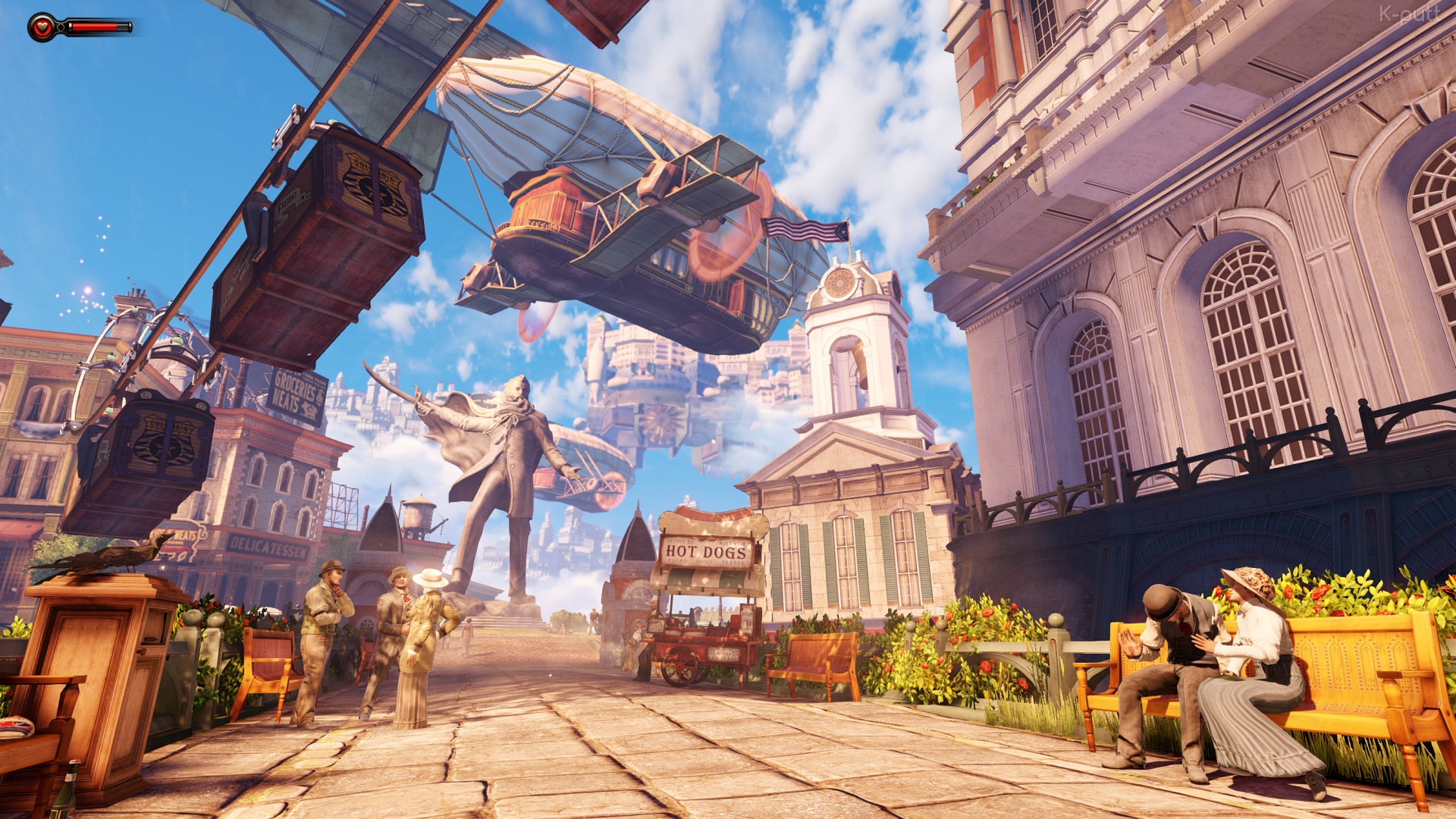
You play as Booker Dewitt(to the left). He's got some debts to settle and believes
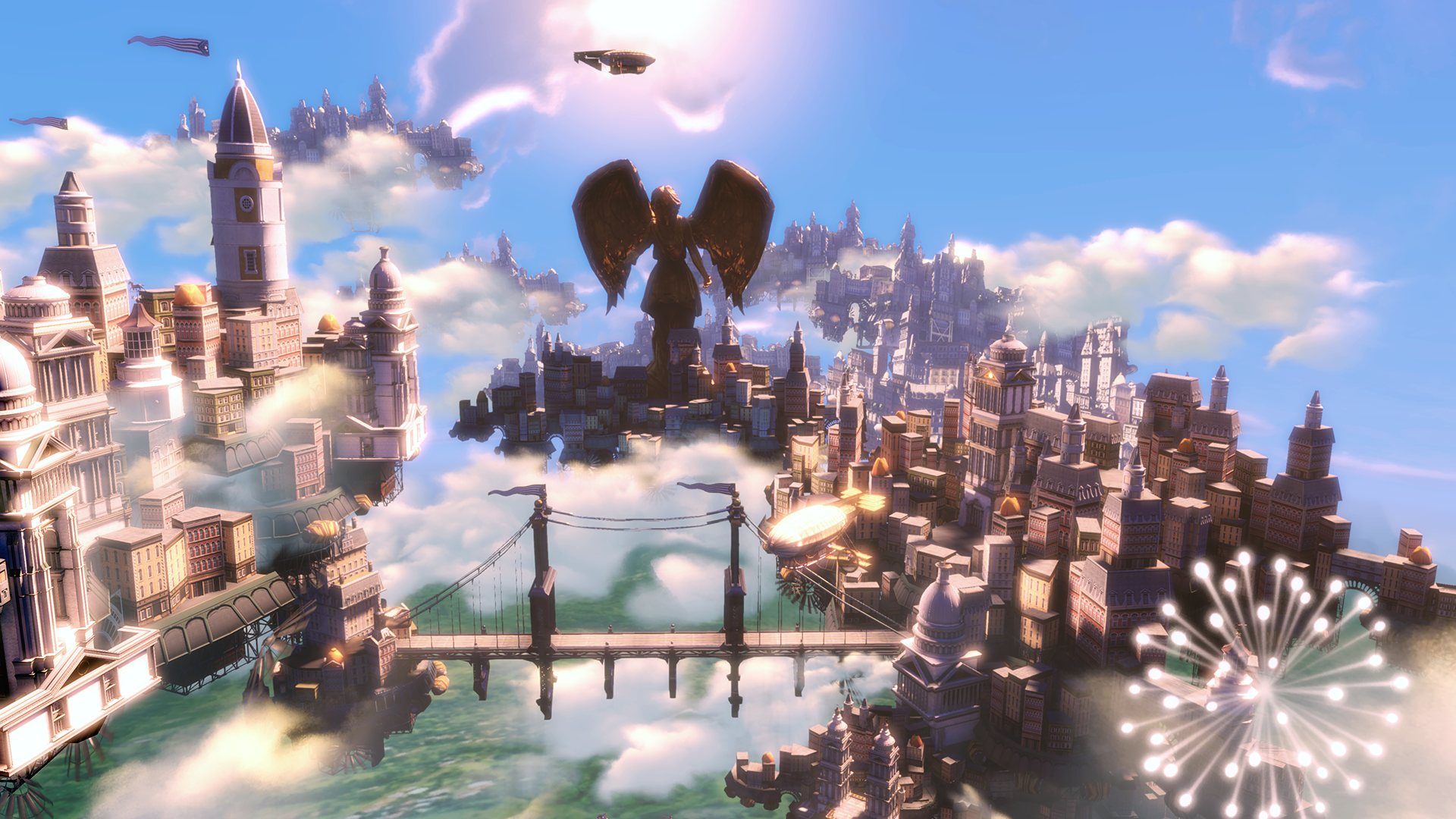
he can do so. He must first venture to the floating city of Columbia.
There he must rescue a young woman named Elizabeth(to the right). But it will not be
easy. Columbia is a city ruled under the watchful eye of Father
Comstock(down left), a prophet who can supposedly see the future. It isn't long
before Booker realizes that rescuing Elizabeth and escaping the city of
Columbia will be much more difficult than he imagined. Quickly branded
as a false prophet, Booker comes under attack.
Like the first
game, Bioshock Infinite is a very thematically ambitious game. One that
begins to elevate storytelling in gaming. There will surely be a lot
of discussion to follow with this one. There's a lot of care taken with
the world in which it takes place in, as well as with some of the
themes it handles. And Bioshock Infinite opts to hold very little back.
Here you'll be tackling themes such as racism, religion, false
prophets, gender roles, even moments that will test your own morals.
It's got a lot to say. The story and the world also come to life in the
same way that Rapture does. While Columbia is not as dazzling as the
trip into the underwater world, it does have a pulse just the same.
You'll find Voxophones scattered throughout. These, like the original
Bioshocks audio diaries, add a lot more to the tale at hand. They add
to the story, the world and the atmosphere. To ignore them is to miss
out on a considerable portion of the game. For those very curious about
the world they're playing in, they will most certainly want to pick this up.
From the outset it doesn't seem as though there is much
which separates Bioshock Infinite from it's predecessor. Indeed, it
takes a moment to get there. Many aspects will be familiar to you from
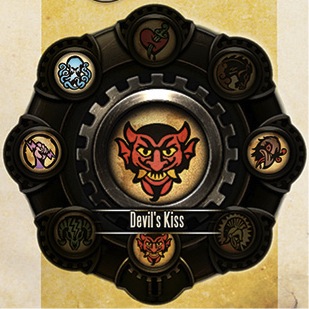
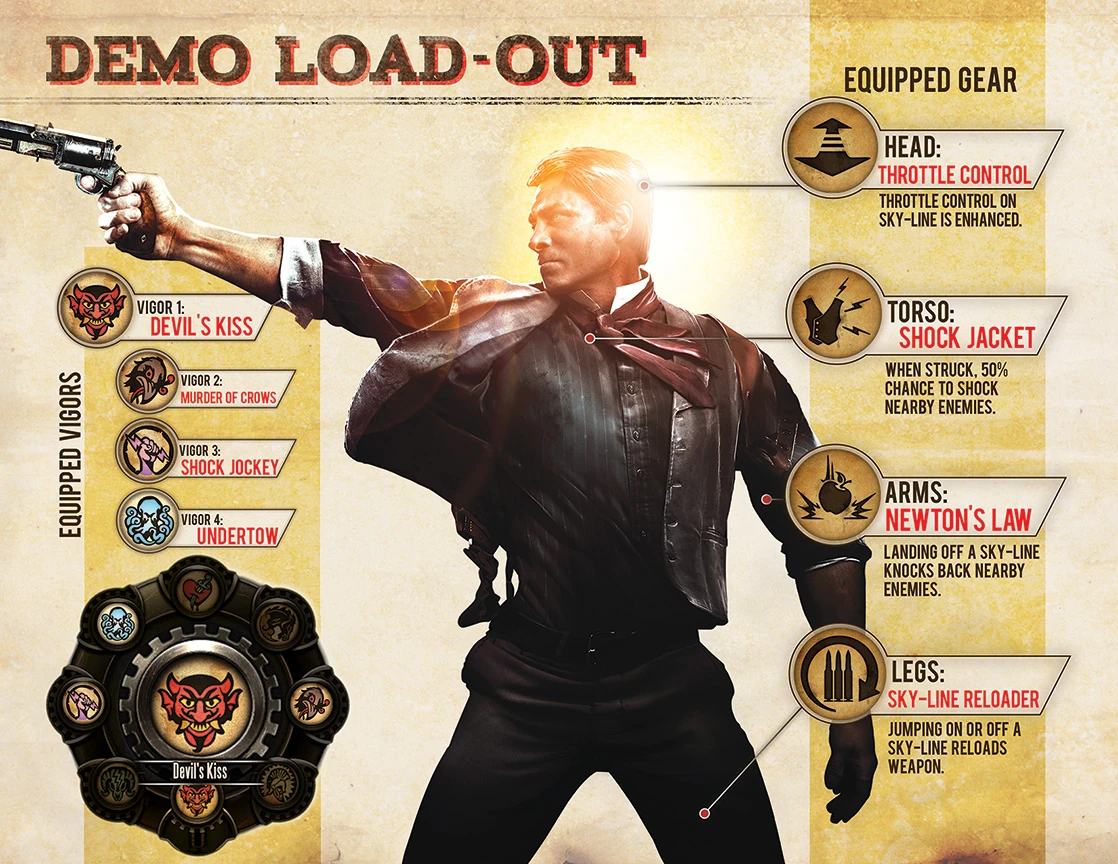
the outset. Instead of Plasmids, for example, you have Vigors(left). These
allow you to do things such as possess machines and make them attack
your enemies, or hurl explosive fireballs at your foes. If there are
crows an area you can even turn them against your foes. There's a lot
variety with the vigors, as well as many different ways to use them.
There is a limit, of course, you need salts to be able to use them.
Like the original there are also vending machines around where you can
use currency to buy upgrades for your vigors or guns. You can also
restore health.
Unlike the original, however, you don't stock up
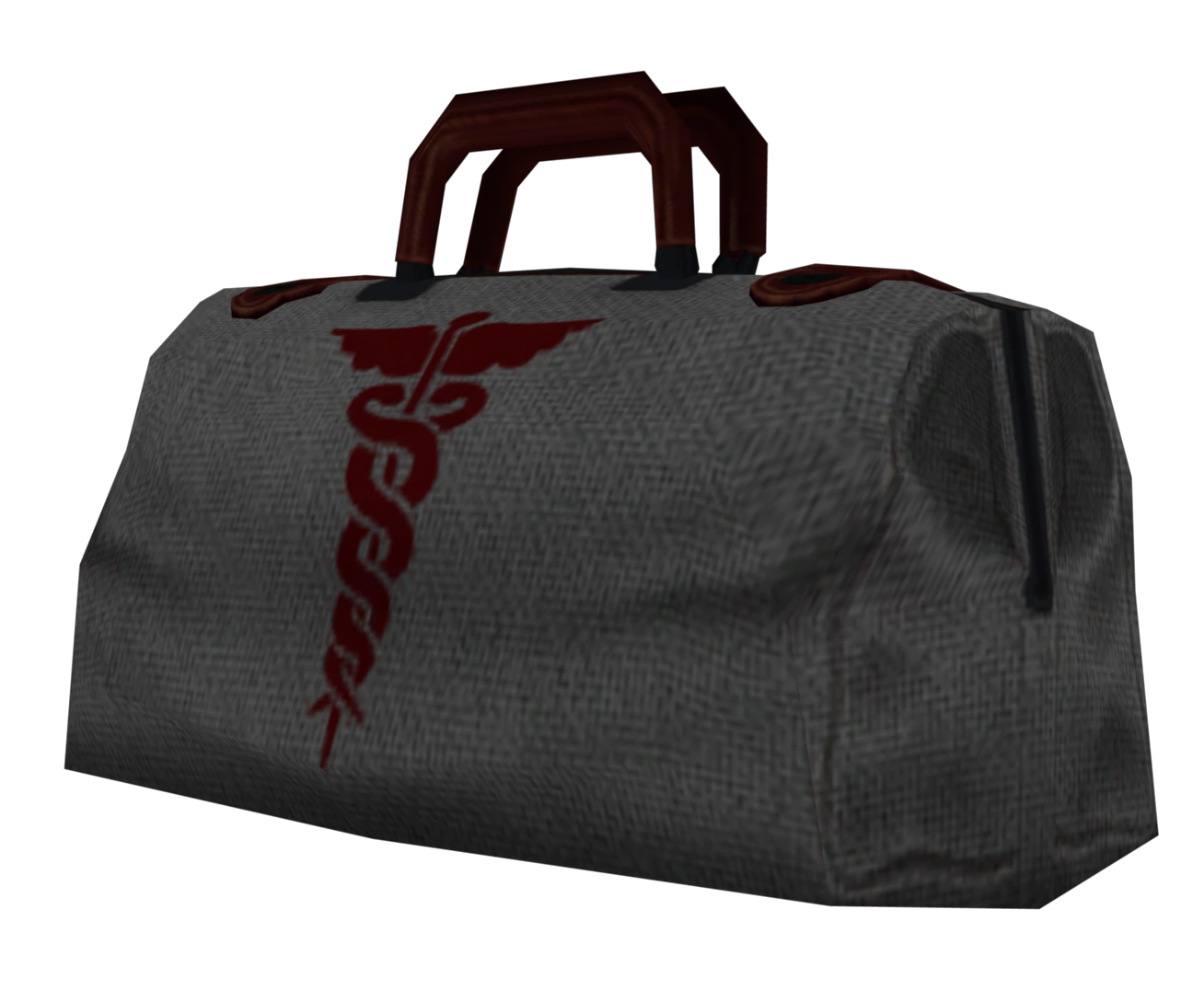
on health packs(left) that will be used immediately when your life reaches
zero. Rather you have one life gauge that doesn't recharge at all. You
must find food or other means of sustenance to restore your health.
There is, however, a shield you'll get early on that does recharge. If
you can find cover in the midst of a gun fight or keep from taking
damage your shield will recharge and you'll be ready again. This seems
like it'll make the game particularly difficult at first, but Bioshock
Infinite is not too challenging in and of itself. Sometimes the enemies
can come in large waves. But should you bite the dust you are never
punished too harshly. You'll respawn really close to where you died and
you'll be given some health and some ammo. Your enemies will also have
some of their health restored as well, so whatever killed you is
usually still lurking. The only downside is that there will be times
when you respawn and you'll need to take time to adjust to your
surroundings. Though you never respawn far from where you've died,
there are times when you'll feel disoriented and turned around when you
do.
There is also gear you can put on to help you out along the
way. These will enhance your abilities. And if you mix and match
things will change. One piece of gear, for instance, allows you to run
faster when your shield burst. Another lets you set people on fire when
you attack them. This adds a layer of strategy and gives you a
different means of approaching the bad guys. Get enough variety of gear
and you'll be able to create different "builds" for your character.
You might think of these builds as various job classes from an RPG.
This all provides many different ways to tackle many of the big
firefights in Bioshock Infinite.
Chances are you won't die too
many times. Bioshock Infinite's biggest change to gameplay is adding
Elizabeth into the equation. Elizabeth will accompany you throughout
much of the experience and as such she is a companion. This isn't some
game where you'll have to babysit, though. Elizabeth can't die.
Although she will supply you with ammunition and health if you need it.
This little tweak can make the game a bit easier than it has to be, but
it won't make death impossible. She also helps you unlock doors when
you come across them, although it is just a tad bit strange that you.
What
really helps Elizabeth along is how well realized of a character she
is. How she develops and her facial expressions give her a lot of life.
To say much more than that would be to spoil a lot of the fun of the
game. Booker is not a bad character, by any means, but the story
quickly lets you know it isn't about him. He's a man with a simple
mission, but this is much more her story than his. She is truly a
loveable and charming character. Not that Booker is bad, but he's
primarily there to make sure you experience the story more so than to
add a lot. While he makes commentary and quips (that are mostly to
provide hints of where to go) every now and then the game makes no
illusions about who is the star of the show here.
That being
said, because of such a huge emphasis on its narrative and story,
Bioshock Infinite often has a real clear path for you to go. It's a
very linear game where you'll rarely (if ever) find yourself lost. That
doesn't mean you can't explore. There is plenty off the beaten path
where you can go off track for a moment to find gear, vigors and
sometimes even going so far as to find a sidequest or two. If you ever
find yourself exploring too much, a tap of a button will show the way to
go in order to get back onto the right path.
Most areas are not
too big, but they are filled to the brim with a lot of details. For the
most part, Bioshock Infinite doesn't look that much different than the
previous two games. This is fine as they were gorgeous looking. Here
there is a lot of detail to the world. One of the chief criticisms
lodged at Bioshock 2 was that we'd already explored quite a bit of
Rapture. A return there wasn't exciting enough. Columbia definitely
is. The tone is very similar, but the atmosphere is not. Instead of
going down dark corridors you're exploring a lot of open spaces. Not
everyone you meet is someone who has lost their mind either (and some do
not even care to try to kill you). Especially in the beginning moments
of the game, you may come across citizens having idle conversation.
Likewise, where as the original Bioshock was pretty dark in its
environment, Infinite is not afraid to let the sunshine in. Many of its
set piece moments stand in contrast to the original.
The audio
is just as good. The sound effects are great. But what is the most
rewarding is listening to the voice acting. All the performances are
great. Comstock, in some cases, can be downright haunting (particularly
listening to him on Voxophone). It helps to make a pretty engaging
experience. If there was anything about the presentation that might be a
bit of a nuisance it might be that from time to time the frame rate can
get a little choppy.
Bioshock Infinite is not for the
weak-hearted however. It's a violent game with some pretty gruesome
death moments. Nothing to cringe worthy for those who have played the
original Bioshock or other violent games. What makes it more startling
is that there is a much deeper context to much of it here. As in,
moments in which you'll see innocent people brutally murdered before
your eyes or treated very poorly. Much of this is put forth for
thematic or story driven purposes. It can be brutal, but it isn't here
just for the sake of shock or as a means to see how far they can push
the envelope. There are many things thrown into Bioshock Infinite as a
means of either reinforcing how horrible the bad guys are, or
reinforcing how horrible the society you're in is. In particular, a lot
of it seems to be done as a means of showing the player just how cruel
this world really is to those they do not deem to actually be worthy.
The enforcement here is to show the player how wrong this "utopia"
they've found themselves on is.
If there was anything about
Bioshock Infinite that immediately sticks out like a sore thumb, it
would be some of the "choices" and "decisions." Some moments you're
able to make certain choices by pushing one trigger or another. The
problem is that the impact of these choices isn't really clear--if they
even manage to change anything at all. At the beginning of the game,
for instance you can choose to throw a baseball at a couple or throw it
at the MC on stage. Regardless of your decision things will play out
the same. It isn't particularly obvious if this has any lasting impact.
It has a bit of an impact later on, but it doesn't really have a major
impact on the story.
Bioshock Infinite isn't a perfect game, but
it is a great one. A thematically ambitious game with a well told
story, Bioshock Infinite is sure to delight fans who fell in love with
the original back in 2007. It is a game that not only delivers well
from a gameplay standpoint, but from a narrative one as well. If you
enjoyed exploring the world of Rapture in 2007, then you'll love going
through the land of Columbia, here.
Pros:
Solid story and narrative that really draws the player in
Very thematically ambitious
Solid gameplay mechanics
A lot of variety in ability and gear to help change up the experience
Elizabeth is a very well crafted character
The music and audio is very good; the voice acting is fantastic
Gorgeous world really draws you into the experience
With Splinter Cell Conviction, Ubisoft decided to make the game
less about stealth and more about brute force. Sure, there was the
option at times of using stealth but I never felt the need to use it.
With Blacklist however, stealth plays a much bigger role. Gone are the
days when it was ok to charge headlong into a room emptying clip after
clip on enemies. While I enjoyed Conviction, Blacklist takes all the
good parts of Conviction and adds much more to it.
For a game
bearing Tom Clancy's name, the plot line is exactly what you would
expect. Terrorists are threatening to destroy something and an elite
group of soldiers have been given carte blanch to stop them. In this
case, terrorists are threatening to destroy the United States by
systematically taking out high value targets, or what they call the
Blacklist -- things like energy, food; basically the backbones of the
country. Sam Fisher of the elite 4th Echelon is tasked by the President
to do anything necessary to stop the attacks. While the plot isn't
spectacular, it serves it purposes to facilitate the missions and lead
you towards the final encounter.
From the first mission it's
evident that there is an enhanced fluidity to movement. It's easy to
slip into the shadows, mantle over cover, climb up a pipe and drop down
onto an unsuspecting enemy. There is a certain satisfaction in sitting
in one spot for several minutes studying enemy movements to really plan
out a route that will either let you slip by completely undetected, or
to divide and conquer without raising any alarms. Each mission allows
you to complete it any number of ways; some force you to remain
undetected while others encourage it by sending in swarms of
reinforcements. It proves beneficial to not start large scale gun
battles.
One complaint I had with Splinter Cell Conviction was,
while stealth was a game mechanic, there was very little true need to
use it. That has completely changed with Blacklist. Sam Fisher can only
take limited damage and when multiple enemies are attacking it can end
very quickly. Planning before the mission is just as important. Deciding
what gadgets and gear to equip before you put boots on the ground is
imperative to making the mission go as smoothly as possible. There is a
wide array of gadgets you can purchase with money earned during the
mission such as smoke bombs, EMP grenades, sticky cameras, sleep gas
grenades, etc. Depending on your play style, there is certain to be gear
you will quickly fall in love with.
Graphically the game looks good.
On Xbox there is an optional HD Texture pack that can be installed from
disc 2. It's approximately 3 GBs of data; honestly if you have the
space just download it for the full effect of the game. Lighting and
shadows are well done. The lights on Sam's suit flare when you are under
cover of darkness. They provide a nice indicator so you are not left
guessing if you are in the shadows or not. Likewise, the sound track and
effects are pretty good as well. They won't win any awards here, but
they don't detract from the game either, but with one exception. I have a
surround sound headset which is perfect for a stealth game like this.
However, on more than one occasion the enemies footsteps did not mesh
with where the enemy was on screen. This created some frustrating
moments when I needed to go off enemy positions purely based on sound.
On
top of the single player campaign there are two multiplayer offering as
well. The first is the fan favorite Spies vs Mercs mode. Spies are
elite, agile stealth-based characters who need to hack certain
terminals, all done in third-person perspective. The Mercs and heavily
armed, first-person based characters whose job is to stops the Spies
from hacking or to kill the spy responsible for the hack before it
completes. Playing as the Merc, there is always a sense of tension as
you search for the spies, knowing at any moment you may be taken down by
a lithe assailant. Conversely, as a Spy you know if you are caught in
the open the fight will end quickly. There are a couple different modes
within the Spies vs Mercs umbrella. Classic 2 vs 2, 4 vs 4, and then
Uplink where there is a combination of Spies and Mercs on the same team.
All three are high tension modes, but when you succeed luring an enemy
into a kill spot and execute it to perfection, there are not many video
game moments that can live up to it.
The other multiplayer mode
is 14 Co-op based missions. These appear as side missions during the
campaign, and all but 4 can technically be done solo. Yet, playing
through these missions with a partner adds an entirely new level of
strategy, planning, and tension. Executing double kills, having a
partner distract a guard so the other can sneak up behind them and
eliminate them is so rewarding. I have never hid the fact that I love
co-op games, missions, or stories. While Conviction had a Co-op mode, it
was a self-contained story and felt more like an add-on. The co-op in
Blacklist feels and plays so well. Enemies rarely do the same thing no
matter how many times you play a mission, so repeating the missions with
different play styles, or partners, still offers an engaging
experience.
I haven't enjoyed a Splinter Cell game this much
since Splinter Cell Chaos Theory. Blacklist went back to the roots of
what made it an outstanding game and added more variety and appealing
gameplay. I have always been a fan of stealth-based games, a few games
claim to be stealth-based but quickly become run and gun games where the
only stealth is hiding when you are waiting for your health to
regenerate. Blacklist is not one of those games. It's a game that forces
you to plan ahead, and rewards you for good choices, and punishes you
for rash decisions.
Pros
Stealth, that actually works and is beneficial
Amazing Co-op and MP modes
Fluid movement
Cons
At times audio is out of sync with events on screen, most notable enemy footsteps
At times the control scheme gets in the way of the game
Splinter
Cell Blacklist is the stealth game that Conviction promised it would
be. With solid gameplay, and fantastic level design, it delivers many
memorable moments while not sacrificing its true vision. Allowing the
player to play anyway they want through almost each mission, and still
feel as though it was the way the developers intended it, is a testament
to how much Ubisoft wanted to get this right. Blacklist is a deeply
rewarding game for those who take their time, plan, and execute a
strategy. If you are looking for a fast paced, run and gun shooter - you
can play like that. If you are looking for a game where you can sneak
past virtually every enemy leaving nothing but a shadow behind, you can
play like that. If you want something in between those you, you can do
that as well. While Conviction was a decent game, Blacklist excels as a
stealth -based game with loads of replayability.
Every minute I spent playing Titanfall, even when I was enjoying it, all that kept running through my mind is what a missed opportunity it was. The gameplay is fun, there's no denying it. It's fast, addictive does feel fresh enough to make it stand out even though it does veer very close to Call of Duty at times. Yet, the universal complaint was its price.I do think if Respawn would have gone all out, given this game a full fledge campaign, maybe even had it support co-op play, and beefed up the online it could have been an absolute killer game. But nope, all you get is multiplayer, don't be fooled by the so called "campaign" mode, it's nothing but multiplayer matches with pathetic little dialogue scenes before each match. As if that's not bad enough, the offerings are as slim as can be. There's hardly any weapons, attachments and zero customization options for your weapons such as paint jobs and alike. There's only several game modes, all of which are your completely standard modes, nothing unique or different and that's it, that's your game. That's not to mention the horrible lag I had in over half of my games (and no it's not my connection because all my other online games run with no problem), and the teams are never randomized so every match just turns into one team dominating the other again and again and again.
So what about the Titan? Well in a nutshell, they're okay. The first few times you get one it's really exciting and it's nice that everyone gets one regardless of whether or not they score any kills. Yet after an hour of playing I got bored of using the Titans and they eventually just feel dull and I often wouldn't even notice I had one ready to call in because the grunt fighting was more exciting. You also aren't able to personalize your Titan in anyway such as with paint or decals which is just bogus since I thought the Titan's are the star of the game, so why not feel more attached to your Titan than just some stock machine dropping in every minute.I'm sure Titanfall will develop its loyal following that will stick with it but people like me will enjoy it for a month or so before returning to whatever their multiplayer game of choice was prior to Titanfall.
Metal Gear Solid 5: Ground Zeroes was released to show off the new Fox engine and let players get accustomed to the new control scheme. It delivers on those two goals. It offers fun gameplay and beautiful graphics (minus one complaint that I have). Considering that MGS 5: The Phantom Pain is two hundred times larger than Ground Zeroes, it is self evident that the price for Ground Zeroes is a bit high. The main mission and the five side missions all take place at the same location. Stealth reaps the highest rewards, as far as scoring goes, but players have the choice of being loud and proud if they so desire. I preordered this game because I thoroughly enjoyed MGS 4 on the PS3, I was anxious to see the new Fox engine in action, and I was ready for a new PS4 game.
The graphics look amazing. Cut scenes are in-engine. Everything looks realistic, and it's easy to suspend disbelief and be drawn into the action. I do have one problem with the graphics, though, and it really stood out to me. I know I'm nitpicking here, but since everything else looks so great, I was disappointed to see this. The issue I'm speaking of concerns the tires on vehicles, mainly the helicopters. The tires look like stop signs, not tires. There were round tires on last generation consoles, so why not on these ultra-powerful new ones? Side view mirrors on the jeeps look just as bad. While this may not matter to a lot of players, I expect more.
The A.I. is okay (normal difficulty), but there is room for improvement. I ran myself into a dead end and there was only one box to hide behind. A group of soldiers saw me go back there, but they did not engage me, nor did they try to draw me out. They simply ran off and said into their radios that they didn't see me anymore. I think the A.I. should know when the player is trapped with only one way out, but they don't. I was also seen going into an armory. They did not remain in the area and wait for me to come out, and they didn't come in to get me. They reported on their radios that I was no longer in sight, and then they just moved on. I hope this is fixed by the time The Phantom Pain releases.
A lot of people are reporting this is a two hour main mission and about another hour worth of side missions. I actually got four and a half hours from the main mission because I thoroughly explored, accosted each soldier, and tried to find everything that I could, all without being spotted. Once I finished four side missions, I had 6.5 hours of gameplay. I haven't unlocked the fifth side mission. Four side missions are unlocked, but the fifth has a requirement (locating all 9 patches during the main mission).
There isn't a lot of story. There are about forty minutes or so of audio logs you can listen to before you play (or whenever you want to listen to them) that offer some story. There are more audio logs you obtain during the game. I like the new map system, but there seems to be an issue with it. During missions, you will discover the location of items that get marked on your map. The issue is that once you collect the item, the marker on the map remains, and this creates confusion. You may find yourself returning to collect an item that you collected earlier, and thus wasting your time. I hope this gets fixed with a patch. I think the final cut scene should have been a playable sequence.
I'm having a lot of fun playing this game. I appreciate good graphics and good gameplay. The controls work nicely. I still have some issues with controlling Snake while he's in the prone position (turning around, for example). Voice actors sound good, but the enemy soldiers' words are cliche.MGS fans will like this prologue, but don't expect a lengthy campaign. If $30 seems high to you, then wait for a price drop. This is more of a demo than a complete title, but it has replay value so you can try different approaches and that adds to the fun factor.