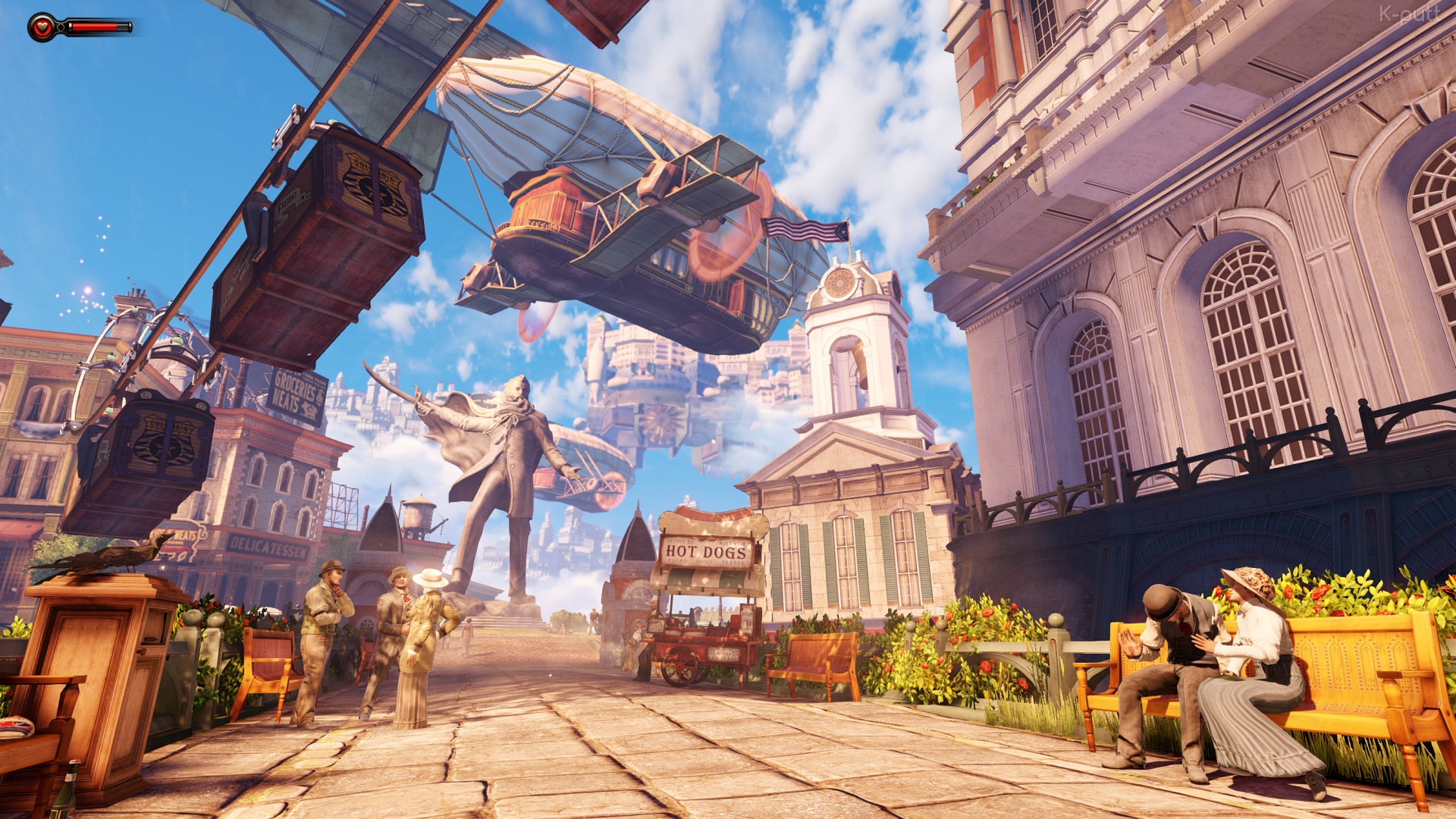
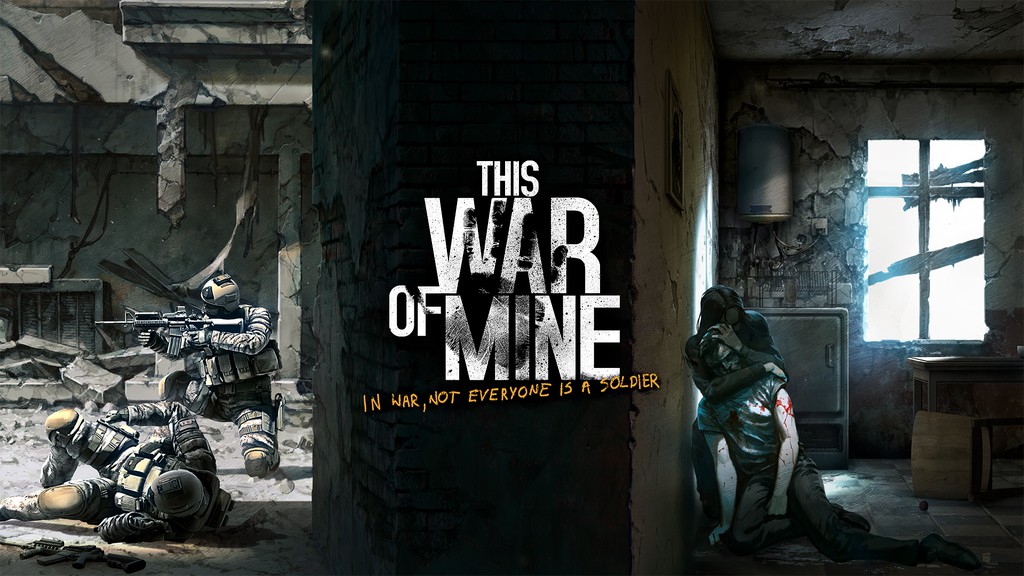
You play as Booker Dewitt(to the left). He's got some debts to settle and believes
he can do so. He must first venture to the floating city of Columbia.
There he must rescue a young woman named Elizabeth(to the right). But it will not be
easy. Columbia is a city ruled under the watchful eye of Father
Comstock(down left), a prophet who can supposedly see the future. It isn't long
before Booker realizes that rescuing Elizabeth and escaping the city of
Columbia will be much more difficult than he imagined. Quickly branded
as a false prophet, Booker comes under attack.
Like the first
game, Bioshock Infinite is a very thematically ambitious game. One that
begins to elevate storytelling in gaming. There will surely be a lot
of discussion to follow with this one. There's a lot of care taken with
the world in which it takes place in, as well as with some of the
themes it handles. And Bioshock Infinite opts to hold very little back.
Here you'll be tackling themes such as racism, religion, false
prophets, gender roles, even moments that will test your own morals.
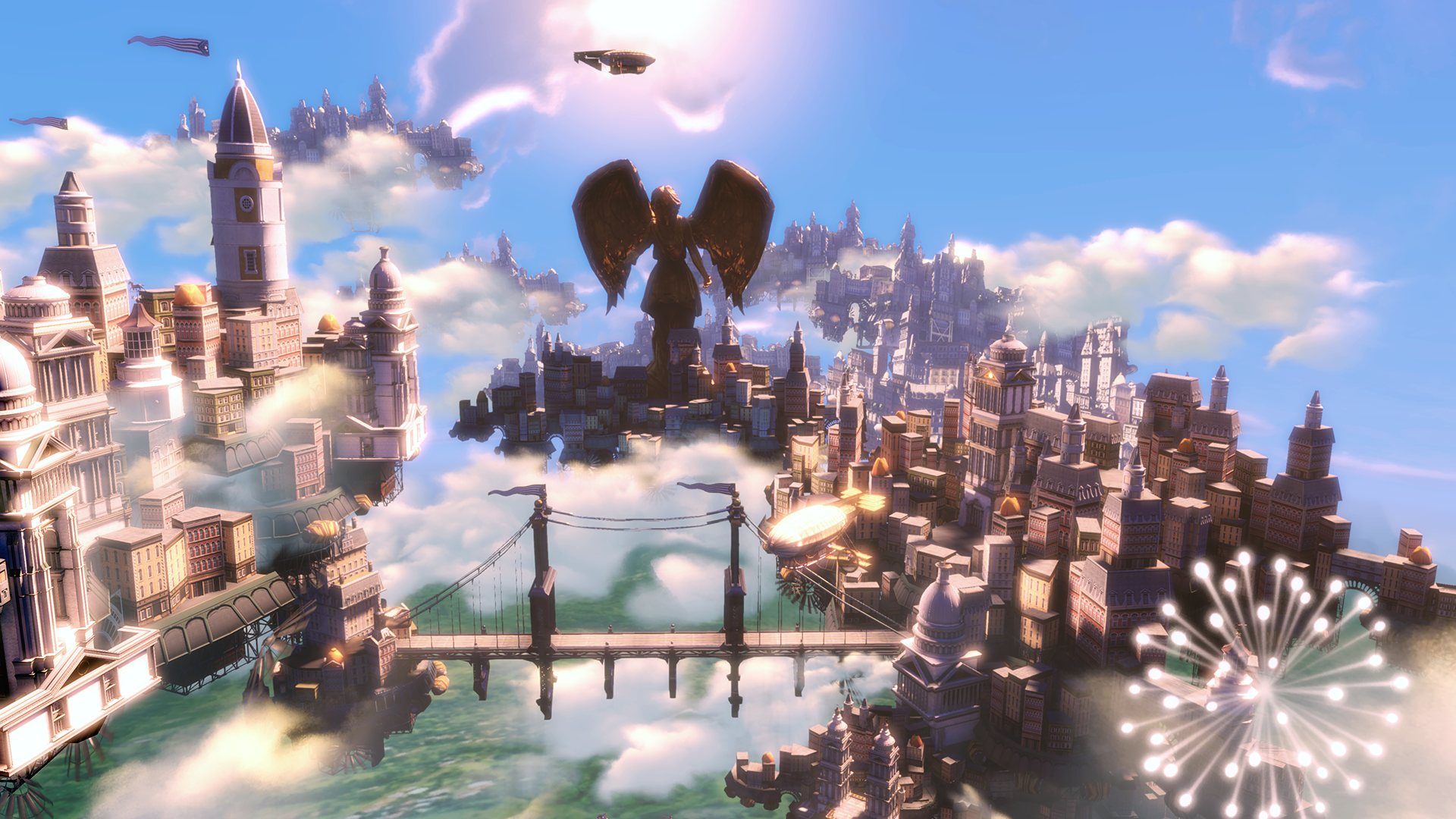
It's got a lot to say. The story and the world also come to life in the
same way that Rapture does. While Columbia is not as dazzling as the
trip into the underwater world, it does have a pulse just the same.
You'll find Voxophones scattered throughout. These, like the original
Bioshocks audio diaries, add a lot more to the tale at hand. They add
to the story, the world and the atmosphere. To ignore them is to miss
out on a considerable portion of the game. For those very curious about
the world they're playing in, they will most certainly want to pick this up.
From the outset it doesn't seem as though there is much
which separates Bioshock Infinite from it's predecessor. Indeed, it
takes a moment to get there. Many aspects will be familiar to you from
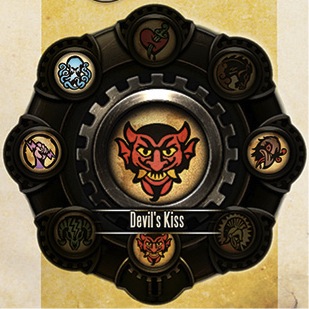
the outset. Instead of Plasmids, for example, you have Vigors(left). These
allow you to do things such as possess machines and make them attack
your enemies, or hurl explosive fireballs at your foes. If there are
crows an area you can even turn them against your foes. There's a lot
variety with the vigors, as well as many different ways to use them.
There is a limit, of course, you need salts to be able to use them.
Like the original there are also vending machines around where you can
use currency to buy upgrades for your vigors or guns. You can also
restore health.
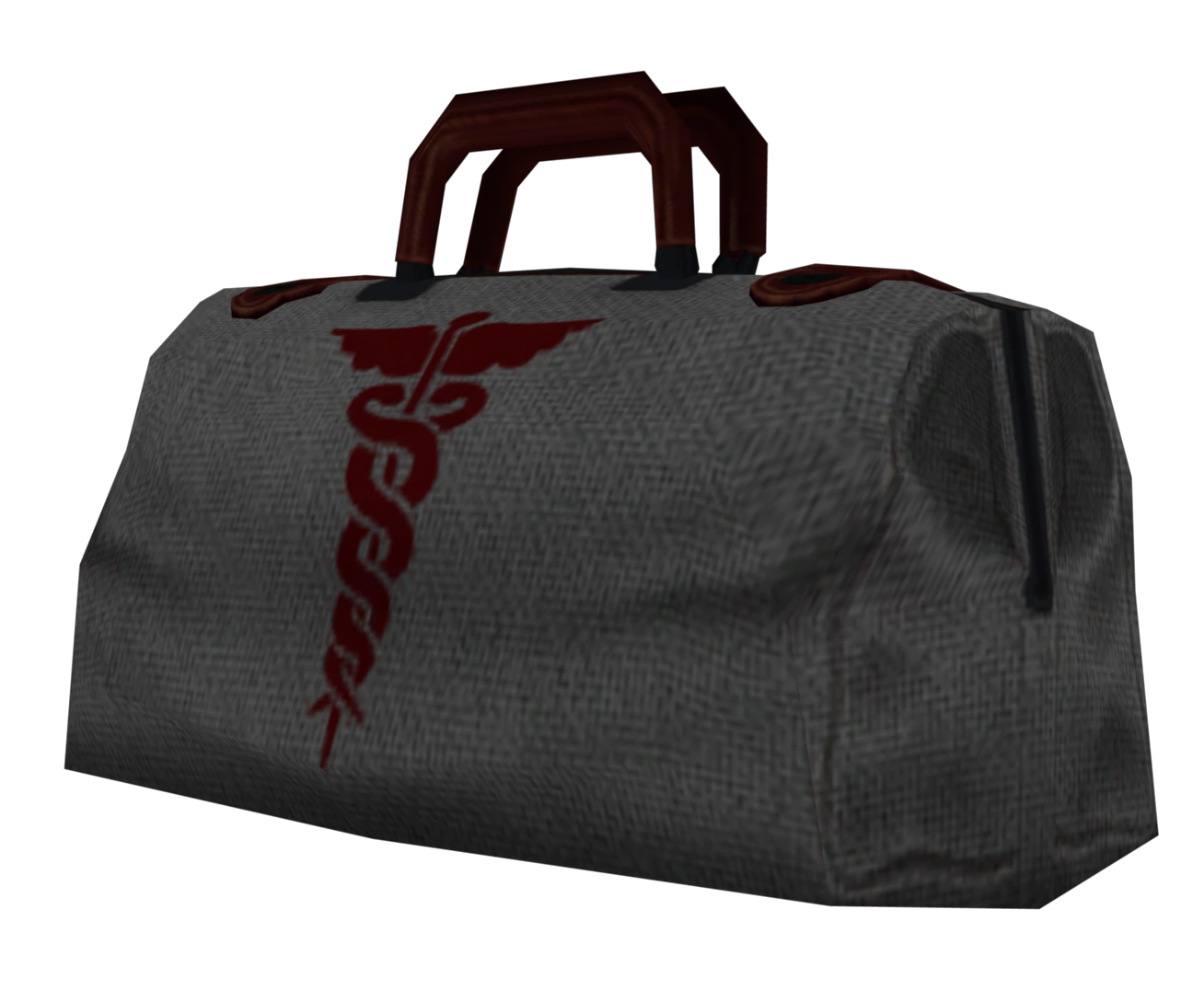
Unlike the original, however, you don't stock up
on health packs(left) that will be used immediately when your life reaches
zero. Rather you have one life gauge that doesn't recharge at all. You
must find food or other means of sustenance to restore your health.
There is, however, a shield you'll get early on that does recharge. If
you can find cover in the midst of a gun fight or keep from taking
damage your shield will recharge and you'll be ready again. This seems
like it'll make the game particularly difficult at first, but Bioshock
Infinite is not too challenging in and of itself. Sometimes the enemies
can come in large waves. But should you bite the dust you are never
punished too harshly. You'll respawn really close to where you died and
you'll be given some health and some ammo. Your enemies will also have
some of their health restored as well, so whatever killed you is
usually still lurking. The only downside is that there will be times
when you respawn and you'll need to take time to adjust to your
surroundings. Though you never respawn far from where you've died,
there are times when you'll feel disoriented and turned around when you
do.
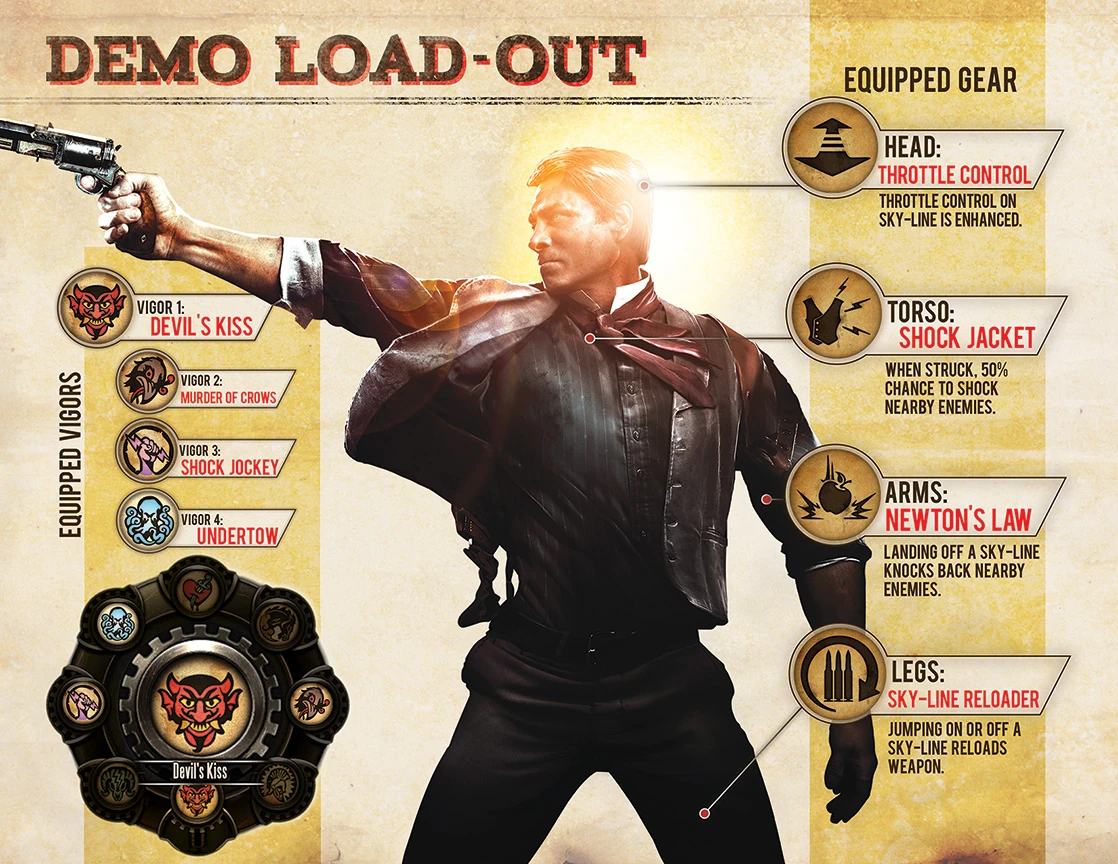
There is also gear you can put on to help you out along the
way. These will enhance your abilities. And if you mix and match
things will change. One piece of gear, for instance, allows you to run
faster when your shield burst. Another lets you set people on fire when
you attack them. This adds a layer of strategy and gives you a
different means of approaching the bad guys. Get enough variety of gear
and you'll be able to create different "builds" for your character.
You might think of these builds as various job classes from an RPG.
This all provides many different ways to tackle many of the big
firefights in Bioshock Infinite.
Chances are you won't die too
many times. Bioshock Infinite's biggest change to gameplay is adding
Elizabeth into the equation. Elizabeth will accompany you throughout
much of the experience and as such she is a companion. This isn't some
game where you'll have to babysit, though. Elizabeth can't die.
Although she will supply you with ammunition and health if you need it.
This little tweak can make the game a bit easier than it has to be, but
it won't make death impossible. She also helps you unlock doors when
you come across them, although it is just a tad bit strange that you.
What
really helps Elizabeth along is how well realized of a character she
is. How she develops and her facial expressions give her a lot of life.
To say much more than that would be to spoil a lot of the fun of the
game. Booker is not a bad character, by any means, but the story
quickly lets you know it isn't about him. He's a man with a simple
mission, but this is much more her story than his. She is truly a
loveable and charming character. Not that Booker is bad, but he's
primarily there to make sure you experience the story more so than to
add a lot. While he makes commentary and quips (that are mostly to
provide hints of where to go) every now and then the game makes no
illusions about who is the star of the show here.
That being
said, because of such a huge emphasis on its narrative and story,
Bioshock Infinite often has a real clear path for you to go. It's a
very linear game where you'll rarely (if ever) find yourself lost. That
doesn't mean you can't explore. There is plenty off the beaten path
where you can go off track for a moment to find gear, vigors and
sometimes even going so far as to find a sidequest or two. If you ever
find yourself exploring too much, a tap of a button will show the way to
go in order to get back onto the right path.
Most areas are not
too big, but they are filled to the brim with a lot of details. For the
most part, Bioshock Infinite doesn't look that much different than the
previous two games. This is fine as they were gorgeous looking. Here
there is a lot of detail to the world. One of the chief criticisms
lodged at Bioshock 2 was that we'd already explored quite a bit of
Rapture. A return there wasn't exciting enough. Columbia definitely
is. The tone is very similar, but the atmosphere is not. Instead of
going down dark corridors you're exploring a lot of open spaces. Not
everyone you meet is someone who has lost their mind either (and some do
not even care to try to kill you). Especially in the beginning moments
of the game, you may come across citizens having idle conversation.
Likewise, where as the original Bioshock was pretty dark in its
environment, Infinite is not afraid to let the sunshine in. Many of its
set piece moments stand in contrast to the original.
The audio
is just as good. The sound effects are great. But what is the most
rewarding is listening to the voice acting. All the performances are
great. Comstock, in some cases, can be downright haunting (particularly
listening to him on Voxophone). It helps to make a pretty engaging
experience. If there was anything about the presentation that might be a
bit of a nuisance it might be that from time to time the frame rate can
get a little choppy.
Bioshock Infinite is not for the
weak-hearted however. It's a violent game with some pretty gruesome
death moments. Nothing to cringe worthy for those who have played the
original Bioshock or other violent games. What makes it more startling
is that there is a much deeper context to much of it here. As in,
moments in which you'll see innocent people brutally murdered before
your eyes or treated very poorly. Much of this is put forth for
thematic or story driven purposes. It can be brutal, but it isn't here
just for the sake of shock or as a means to see how far they can push
the envelope. There are many things thrown into Bioshock Infinite as a
means of either reinforcing how horrible the bad guys are, or
reinforcing how horrible the society you're in is. In particular, a lot
of it seems to be done as a means of showing the player just how cruel
this world really is to those they do not deem to actually be worthy.
The enforcement here is to show the player how wrong this "utopia"
they've found themselves on is.
If there was anything about
Bioshock Infinite that immediately sticks out like a sore thumb, it
would be some of the "choices" and "decisions." Some moments you're
able to make certain choices by pushing one trigger or another. The
problem is that the impact of these choices isn't really clear--if they
even manage to change anything at all. At the beginning of the game,
for instance you can choose to throw a baseball at a couple or throw it
at the MC on stage. Regardless of your decision things will play out
the same. It isn't particularly obvious if this has any lasting impact.
It has a bit of an impact later on, but it doesn't really have a major
impact on the story.
Bioshock Infinite isn't a perfect game, but
it is a great one. A thematically ambitious game with a well told
story, Bioshock Infinite is sure to delight fans who fell in love with
the original back in 2007. It is a game that not only delivers well
from a gameplay standpoint, but from a narrative one as well. If you
enjoyed exploring the world of Rapture in 2007, then you'll love going
through the land of Columbia, here.
Pros:
Solid story and narrative that really draws the player in
Very thematically ambitious
Solid gameplay mechanics
A lot of variety in ability and gear to help change up the experience
Elizabeth is a very well crafted character
The music and audio is very good; the voice acting is fantastic
Gorgeous world really draws you into the experience
With Splinter Cell Conviction, Ubisoft decided to make the game
less about stealth and more about brute force. Sure, there was the
option at times of using stealth but I never felt the need to use it.
With Blacklist however, stealth plays a much bigger role. Gone are the
days when it was ok to charge headlong into a room emptying clip after
clip on enemies. While I enjoyed Conviction, Blacklist takes all the
good parts of Conviction and adds much more to it.
For a game
bearing Tom Clancy's name, the plot line is exactly what you would
expect. Terrorists are threatening to destroy something and an elite
group of soldiers have been given carte blanch to stop them. In this
case, terrorists are threatening to destroy the United States by
systematically taking out high value targets, or what they call the
Blacklist -- things like energy, food; basically the backbones of the
country. Sam Fisher of the elite 4th Echelon is tasked by the President
to do anything necessary to stop the attacks. While the plot isn't
spectacular, it serves it purposes to facilitate the missions and lead
you towards the final encounter.
From the first mission it's
evident that there is an enhanced fluidity to movement. It's easy to
slip into the shadows, mantle over cover, climb up a pipe and drop down
onto an unsuspecting enemy. There is a certain satisfaction in sitting
in one spot for several minutes studying enemy movements to really plan
out a route that will either let you slip by completely undetected, or
to divide and conquer without raising any alarms. Each mission allows
you to complete it any number of ways; some force you to remain
undetected while others encourage it by sending in swarms of
reinforcements. It proves beneficial to not start large scale gun
battles.
One complaint I had with Splinter Cell Conviction was,
while stealth was a game mechanic, there was very little true need to
use it. That has completely changed with Blacklist. Sam Fisher can only
take limited damage and when multiple enemies are attacking it can end
very quickly. Planning before the mission is just as important. Deciding
what gadgets and gear to equip before you put boots on the ground is
imperative to making the mission go as smoothly as possible. There is a
wide array of gadgets you can purchase with money earned during the
mission such as smoke bombs, EMP grenades, sticky cameras, sleep gas
grenades, etc. Depending on your play style, there is certain to be gear
you will quickly fall in love with.
Graphically the game looks good.
On Xbox there is an optional HD Texture pack that can be installed from
disc 2. It's approximately 3 GBs of data; honestly if you have the
space just download it for the full effect of the game. Lighting and
shadows are well done. The lights on Sam's suit flare when you are under
cover of darkness. They provide a nice indicator so you are not left
guessing if you are in the shadows or not. Likewise, the sound track and
effects are pretty good as well. They won't win any awards here, but
they don't detract from the game either, but with one exception. I have a
surround sound headset which is perfect for a stealth game like this.
However, on more than one occasion the enemies footsteps did not mesh
with where the enemy was on screen. This created some frustrating
moments when I needed to go off enemy positions purely based on sound.
On
top of the single player campaign there are two multiplayer offering as
well. The first is the fan favorite Spies vs Mercs mode. Spies are
elite, agile stealth-based characters who need to hack certain
terminals, all done in third-person perspective. The Mercs and heavily
armed, first-person based characters whose job is to stops the Spies
from hacking or to kill the spy responsible for the hack before it
completes. Playing as the Merc, there is always a sense of tension as
you search for the spies, knowing at any moment you may be taken down by
a lithe assailant. Conversely, as a Spy you know if you are caught in
the open the fight will end quickly. There are a couple different modes
within the Spies vs Mercs umbrella. Classic 2 vs 2, 4 vs 4, and then
Uplink where there is a combination of Spies and Mercs on the same team.
All three are high tension modes, but when you succeed luring an enemy
into a kill spot and execute it to perfection, there are not many video
game moments that can live up to it.
The other multiplayer mode
is 14 Co-op based missions. These appear as side missions during the
campaign, and all but 4 can technically be done solo. Yet, playing
through these missions with a partner adds an entirely new level of
strategy, planning, and tension. Executing double kills, having a
partner distract a guard so the other can sneak up behind them and
eliminate them is so rewarding. I have never hid the fact that I love
co-op games, missions, or stories. While Conviction had a Co-op mode, it
was a self-contained story and felt more like an add-on. The co-op in
Blacklist feels and plays so well. Enemies rarely do the same thing no
matter how many times you play a mission, so repeating the missions with
different play styles, or partners, still offers an engaging
experience.
I haven't enjoyed a Splinter Cell game this much
since Splinter Cell Chaos Theory. Blacklist went back to the roots of
what made it an outstanding game and added more variety and appealing
gameplay. I have always been a fan of stealth-based games, a few games
claim to be stealth-based but quickly become run and gun games where the
only stealth is hiding when you are waiting for your health to
regenerate. Blacklist is not one of those games. It's a game that forces
you to plan ahead, and rewards you for good choices, and punishes you
for rash decisions.
Pros
Stealth, that actually works and is beneficial
Amazing Co-op and MP modes
Fluid movement
Cons
At times audio is out of sync with events on screen, most notable enemy footsteps
At times the control scheme gets in the way of the game
Splinter
Cell Blacklist is the stealth game that Conviction promised it would
be. With solid gameplay, and fantastic level design, it delivers many
memorable moments while not sacrificing its true vision. Allowing the
player to play anyway they want through almost each mission, and still
feel as though it was the way the developers intended it, is a testament
to how much Ubisoft wanted to get this right. Blacklist is a deeply
rewarding game for those who take their time, plan, and execute a
strategy. If you are looking for a fast paced, run and gun shooter - you
can play like that. If you are looking for a game where you can sneak
past virtually every enemy leaving nothing but a shadow behind, you can
play like that. If you want something in between those you, you can do
that as well. While Conviction was a decent game, Blacklist excels as a
stealth -based game with loads of replayability.
Every minute I spent playing Titanfall, even when I was enjoying it, all that kept running through my mind is what a missed opportunity it was. The gameplay is fun, there's no denying it. It's fast, addictive does feel fresh enough to make it stand out even though it does veer very close to Call of Duty at times. Yet, the universal complaint was its price.I do think if Respawn would have gone all out, given this game a full fledge campaign, maybe even had it support co-op play, and beefed up the online it could have been an absolute killer game. But nope, all you get is multiplayer, don't be fooled by the so called "campaign" mode, it's nothing but multiplayer matches with pathetic little dialogue scenes before each match. As if that's not bad enough, the offerings are as slim as can be. There's hardly any weapons, attachments and zero customization options for your weapons such as paint jobs and alike. There's only several game modes, all of which are your completely standard modes, nothing unique or different and that's it, that's your game. That's not to mention the horrible lag I had in over half of my games (and no it's not my connection because all my other online games run with no problem), and the teams are never randomized so every match just turns into one team dominating the other again and again and again.
So what about the Titan? Well in a nutshell, they're okay. The first few times you get one it's really exciting and it's nice that everyone gets one regardless of whether or not they score any kills. Yet after an hour of playing I got bored of using the Titans and they eventually just feel dull and I often wouldn't even notice I had one ready to call in because the grunt fighting was more exciting. You also aren't able to personalize your Titan in anyway such as with paint or decals which is just bogus since I thought the Titan's are the star of the game, so why not feel more attached to your Titan than just some stock machine dropping in every minute.I'm sure Titanfall will develop its loyal following that will stick with it but people like me will enjoy it for a month or so before returning to whatever their multiplayer game of choice was prior to Titanfall.
Metal Gear Solid 5: Ground Zeroes was released to show off the new Fox engine and let players get accustomed to the new control scheme. It delivers on those two goals. It offers fun gameplay and beautiful graphics (minus one complaint that I have). Considering that MGS 5: The Phantom Pain is two hundred times larger than Ground Zeroes, it is self evident that the price for Ground Zeroes is a bit high. The main mission and the five side missions all take place at the same location. Stealth reaps the highest rewards, as far as scoring goes, but players have the choice of being loud and proud if they so desire. I preordered this game because I thoroughly enjoyed MGS 4 on the PS3, I was anxious to see the new Fox engine in action, and I was ready for a new PS4 game.
The graphics look amazing. Cut scenes are in-engine. Everything looks realistic, and it's easy to suspend disbelief and be drawn into the action. I do have one problem with the graphics, though, and it really stood out to me. I know I'm nitpicking here, but since everything else looks so great, I was disappointed to see this. The issue I'm speaking of concerns the tires on vehicles, mainly the helicopters. The tires look like stop signs, not tires. There were round tires on last generation consoles, so why not on these ultra-powerful new ones? Side view mirrors on the jeeps look just as bad. While this may not matter to a lot of players, I expect more.
The A.I. is okay (normal difficulty), but there is room for improvement. I ran myself into a dead end and there was only one box to hide behind. A group of soldiers saw me go back there, but they did not engage me, nor did they try to draw me out. They simply ran off and said into their radios that they didn't see me anymore. I think the A.I. should know when the player is trapped with only one way out, but they don't. I was also seen going into an armory. They did not remain in the area and wait for me to come out, and they didn't come in to get me. They reported on their radios that I was no longer in sight, and then they just moved on. I hope this is fixed by the time The Phantom Pain releases.
A lot of people are reporting this is a two hour main mission and about another hour worth of side missions. I actually got four and a half hours from the main mission because I thoroughly explored, accosted each soldier, and tried to find everything that I could, all without being spotted. Once I finished four side missions, I had 6.5 hours of gameplay. I haven't unlocked the fifth side mission. Four side missions are unlocked, but the fifth has a requirement (locating all 9 patches during the main mission).
There isn't a lot of story. There are about forty minutes or so of audio logs you can listen to before you play (or whenever you want to listen to them) that offer some story. There are more audio logs you obtain during the game. I like the new map system, but there seems to be an issue with it. During missions, you will discover the location of items that get marked on your map. The issue is that once you collect the item, the marker on the map remains, and this creates confusion. You may find yourself returning to collect an item that you collected earlier, and thus wasting your time. I hope this gets fixed with a patch. I think the final cut scene should have been a playable sequence.
I'm having a lot of fun playing this game. I appreciate good graphics and good gameplay. The controls work nicely. I still have some issues with controlling Snake while he's in the prone position (turning around, for example). Voice actors sound good, but the enemy soldiers' words are cliche.MGS fans will like this prologue, but don't expect a lengthy campaign. If $30 seems high to you, then wait for a price drop. This is more of a demo than a complete title, but it has replay value so you can try different approaches and that adds to the fun factor.
Picture this. You walk into a room while a pack of murderous looters are just outside the door, ready to shoot you on site. There are two generators in this room that you have to activate, because you have to trip an emergency evacuation alarm to open the exit. But when you do this, you realize that you've also activated an android who will bash your skull open if it sees you, and attracted the attention of a vicious predator in the air vents above you. You sneak around, throwing a makeshift noisemaker to distract both your assailants, and frantically use a device to hack into the security system while they investigate the racket. Suddenly, the alarm trips. Lights flash. Everybody is aware of your presence. Frantically, you turn tail and run right into the hall full of looters. You think you're safe, that maybe they're gone. But what you didn't notice was the disgusting slime coming from a vent dead ahead. Before you know it, a Xenomorph snatches you up and everything cuts to black, all because you were too busy panicking to pay attention.
This type of experience is par for the course in "Alien: Isolation," the new survival horror game/apology for "Aliens: Colonial Marines" from Sega and Creative Assembly. There has been a lot of talk, recently, about a revival of survival horror games. But the fact of the matter is, most horror games that attempt to breathe life into the genre stumble and miss the mark way more than they succeed. They're too focused on jump scares, or letting players shoot the enemies with a huge arsenal of weapons. Even the upcoming "The Evil Within," by the prolific Shinji Mikami, looks to make concessions towards modern AAA gaming, and to not be focused on true survival and true horror. Yet I'm happy to say "Isolation," a licensed game of all things, is the first game in a long, long time that I've felt can truly be called "survival horror." As in, you're trying desperately to survive, and dear lord, is it horrific.
Part of that horror comes from the inspiration behind the game itself. It's made very clear that this game is not inspired by "Aliens," James Cameron's sequel to Ridley Scott's original "Alien", which most games in this franchise have been based upon. No, what we have instead is a quasi-sequel set after the events of the first film, when space marines weren't a thing and Xenomorphs weren't being overpowered by giant robotic suits. It's just the player, taking the role of series heroine Ellen Ripley's daughter, Amanda, one Xenomorph, and an army of assailants both human and cybernetic. She's searching for answers to her mother's disappearance after the events of the first film, and gets roped into exploring a derelict space colony formerly owned by Seegson, a second-rate corporation with big dreams and shady practices. But those answers will have to come later, with everything and seemingly everyone in the colony working together to kill her in the worst ways possible. And, y'know, the aforementioned Xenomorph doesn't help at all.
Some critics have questioned the significance of "Isolation"'s narrative, and I can't see why. I would actually say this is one of the best additions to the series canon in a long while, and certainly an improvement on the narrative roadkill that was "Colonial Marines." It expands upon the "Alien" universe in a myriad of new, intriguing ways, in my opinion. The most major of these would be the introduction of Seegson, whose turbulent history and unsavory behavior is chronicled through various logs throughout the game. Theirs is a story of corporate espionage and broken promises that helps to paint a fuller picture of the effects both space colonization and the reach of the sinister Weyland-Yutani Corporation have had on humanity. Long story short? They're the cheap knock-off of their bigger and better competitor, and throughout the game, that shows in various ways that I wouldn't dream of spoiling.
Another way that this expands on series canon in important ways is the development of Amanda as a character. Previously, she had been mentioned only as an already-deceased old woman in "Aliens" after her mother woke up from cryo-stasis, and thus, seemed like an insignificant footnote to the Ripley bloodline. But here, we get to see her as much younger, less dead entity. It's a good thing, too, because Amanda Ripley is one of the more memorable female characters I've played as in a video game, period. Much like her mother, she may be thrown into several horrifying and deadly situations, but she's never playing the victim. By her wits, determination, and physical strength, she always has the leg up on the opposition... it's just up to the player to figure out exactly how. Add on a fierce sense of dry wit and a rugged determination to get what she wants, and you've got one of the best characters of 2014 so far.
None of the important narrative choices would matter, though, if the game itself wasn't fun to play. And in some ways, it isn't... in the absolute best way possible. "Isolation" is a brutal, unforgiving game in which players need to get used to dying, restarting, and then dying shortly thereafter. Despite the way some trailers make it look, this is not a first-person shooter. There are guns, yes, and occasionally you'll have a use for them... when they're not attracting other threats which no weapon can kill. See, this is a survival/stealth game, in which players need to stick to the shadows and air vents if they want to actually get through the whole experience in one piece. Every situation is a puzzle, in a way, and using a gun (outside of certain situations) is a form of desperate resignation, because it indicates that you can't think of any other way to solve that puzzle. And in all likelihood, there's an answer that you're just overlooking.
To compensate for barely any ammo and purposefully ineffective weapons, there's a wealth of scrap materials laying around the colony to make some useful survival tools. A molotov cocktail will scare the Xenomorph back into the vents for some time, for example, and a noisemaker will make any attackers look elsewhere while you give them the slip. Scavenging for raw materials to craft new items is not a feature, it's a necessity. Having to do it in real time also adds to the tension, as you cross your fingers that won't get mauled while trying to make something to heal yourself. With severely limited slots and the requirement of total stealth to effectively craft, "Isolation" really drives home the survival aspect of survival horror, and it's a joy to experience. A tense, stressful kind of joy, yes, but a joy nonetheless.
But what about the horror side of things? The game may be hard and push a focus on terse survival situations, but is it actually scary? It would be an understatement to say "yes" to that question, because "Isolation" is downright terrifying at times, and simply mildly terrifying the rest of the time. Most horror games fail to scare me these days. "Amnesia" is more frustrating than scary, "Outlast" wore out its welcome halfway through, "Slender" is a gimmicky festival of jump scares... frankly, none of these supposedly "scary" games successfully shake me up. At most, they'll just startle me for a few moments, and then I'll just go about my merry way. Not so with "Isolation." Death is a constant threat here.
The unnerving androids dubbed "Working Joes" are what really do it for me, to be honest. Their glowing eyes, expressionless faces, and vague threats freak me out, as do their ability to pursue you while on fire and melting right before your eyes. If you get anywhere close to them, they'll lift you up and start throttling you without a moment's hesitation. Quite the disturbing experience, especially when you consider that only a few things can actually do damage to them, like a shotgun blast to the cranium. They'll grab your melee attacks, walking through your flamethrower, take five or six shots to the head with a pistol... unexpectedly, the original foes that Creative Assembly are the most interesting enemies in the game, and are sure to keep me looking over my shoulders for quite a while. Thanks, guys!
Which isn't to say that the Xenomorph itself isn't enough to make me yelp out loud, because it is. As I mentioned above, death is an ever-looming threat, and that's thanks to the creature. It will stomp around on the floor, go through the vents, rip you out of hiding places, and just about anything else in its power to end you. And rest assured, it will end you. Unlike the Working Joes, there's no chance for escaping this thing's grasp. Once it has you, it's over, and the amount of ways in which it can kill you is staggering. Walk under a vent with some weird liquid coming from it? You're dead. Try to outrun it once it's spotted you? You're really dead. Attempt to shoot it once it gets close enough to you? Completely and utterly dead. The only thing you can really do is use the flamethrower and molotovs to scare it away for a while, but ultimately, your best bet is to use your motion tracker and never let it even know you're there.
That's easier said than done, though, thanks to the fantastic AI. As you're not the only human in the colony, the Alien will sometimes drop in and kill five or six people in a matter of seconds, then finish you off... or run away... or perhaps not even show up in the first place. 90% of the time I thought I was witnessing a triggered, pre-determined event, I was triumphantly proven wrong. The Xenomorph is dynamic and constantly moving, constantly changing up its game, and it's pretty much impossible to predict what it's going to do next. You just need to prepared when it does decide to do something, unless you want to get impaled or decapitated.
These two enemy types, along with the desperate remaining humans, make the atmosphere of "Isolation" reek entirely of dread. Coupled with a ship that's always falling apart in some way, shape or form, and ominous lighting that made me genuinely afraid to go into certain rooms, the entire game is tense and terrifying, one of the scariest in years. Yet unlike most new horror games, players are actually given the chance to fight back and survive. You don't get a little lantern or camcorder, then thrown into the trenches. The controls are buttery smooth, the aforementioned crafting system works like a charm, and there's materials to be used everywhere if you look hard enough. Yes, death is a constant threat, but one that can always be avoided if you play it smart.
My concerns with the gameplay are minimal thanks to all of that good stuff, but still worth mentioning. First off, the Xenomorph's movements can be wildly inconsistent. Sometimes, it chases you at a normal pace, and others, it's able to catch up from 40-50 feet away in a matter of seconds. It reminds me of the arbitrary way in which some characters in last place can suddenly pull ahead in a game of "Mario Kart," able to somehow speed up enough to leave you in the dust thanks to video game magic. Except, in "Mario Kart," you're not going to get rammed through the gut and forced to go back to the last manual save point. So while I admire the dynamic AI present with the Xenomorph, and I enjoy the sense of tension created by having no auto-saves, there are some serious balance issues that should have been addressed.
Another major issue is the occasionally frustrating way in which players are lead through the game. Now, I hate hand-holding in most games, and love being forced to learn a map and explore. The thing is, the way in which players are lead through the story can be a bit confusing sometimes. In some instances, a player will have a clear blip on their radar, and then have to uncover the map as they go along towards said blip. That's fine. But then other times, players won't have the entire map yet and will be told to go places, yet they have no clue where they're going because there's no indicator on the map. Also, the different levels of maps aren't made clear in the interface, leaving it up to a player's guesswork as to which floor they're on. One might make the case that this lack of instruction makes for a more tense experience, and in some aspects, I can get behind that sentiment. At the same time, clearer directions and a better map system would have greatly benefited the experience as a whole.
At least wherever you stumble next will most likely look really, really good, thanks to masterful art direction and stunning lighting. Despite some occasional sameness when it comes down to some of the predominately grey and black rooms present here, most of the colony (and other places you'll set foot on) is interesting to look at, and rendered with lovely visuals. Everything has a very nice 70's sci-fi sheen to it, what with the usage of cassette tapes and the clunky, plastic-looking structures that surround you. Simply put, it looks very much like the original film and its vision of the future, and is aided by Geiger-esque design for the Xenomorph and everything related to it. While some might say that we should be aiming to create newer-looking worlds for games, I think it's admirable that Creative Assembly tried to remain as faithful to the "Alien" universe as possible. It paid off, too, because almost everything looks gorgeous here, and it's easy to stop and just take in some of the scenery when you're not being hunted down.
In the wake of the absolute disaster that was "Aliens: Colonial Marines," I didn't see this one coming from a mile away. A developer primarily responsible for strategy games trying its hand at a first-person survival horror game? I was understandably skeptical, as were most. Yet "Alien: Isolation" goes above and beyond all expectations I had set forth for it. At best, I was hoping for a mildly tense, shiny-looking game that was predominately linear and eventually turned into a form of a shooter. Instead, I got an extremely disturbing experience which is impressively open-ended and focused on stealth over brute force. For people who want to be led through a series of jump scares and then patted on the back, this is a horrible experience. But for people who want a game that demands thought and requires strategy, and features scares that will last long after the credits roll, it's a pure triumph.
"Alien: Isolation" is a new benchmark in survival horror for me, and one I doubt many games will hit or exceed for a while. Even if it does make me want to throw my controller into the TV thanks to a cheap kill sometimes.
This is an arcade style racing game. Remember that when reading reviews on "realistic" or "not as good as forza/GT series" as this is a different type of game. Summary: 7/10
This game is Need for speed meets an MMO.Therefore, you need a constant internet connection to play this game...even in single player. If you like arcade racing games and are looking for a large world, this game may be for you. If you have 2 kids or multiple friends who like racing games, this would be fun with people. Some missions feel useless and the overall the graphics are not top tier (they are good, just won't require a top tier graphics card to hit max settings), but the game definitely is fun with friends. There are short comings (the User interface is annoying at times, my personal disappointment with the graphics, some useless missions) but most can be overlooked for really what this game does different. It brings you and your friends together to do missions (like any MMO) but with racing cars instead of wizards.
Graphics: 8/10
for Console capability
They are beautiful, but not as good as you expected if you watched the trailers. This is due to them using CGI for their ads. So take that into consideration. It is not as pretty as other racing games in terms of car detail, but 30fps and 1080p on both consoles will leave you in a good spot. The scenery is beautiful and exactly what was advertised from what I can see. Physics: 6/10
until you disable the driver assist, then it becomes 8/10.
For arcade racing.
Not racing sim.
Where to start...I would compare this to the older NFS Hot pursuit 2 or even midnight club. I had to immediately turn off the racing assist as with it, I just was all over the place. I would say that it takes some getting used to, but after awhile of driving around, it felt like a normal arcade game. They can still do improvement to reduce the over-steer and not make the cars so light. Background/world size: 9/10
I have to say, they did an excellent job with the cities and scenery that they did produce in the game. I really enjoyed the feel of being in different parts of the US. It gave an authentic feel. The large landscapes give you the feel of how big the US is at times, but also how small cities can be.
The one thing I hope they do, like other MMOs, is add more cities. There just are not as many as I wanted Car Models: 7/10
The cars are fairly well done, not the best you will see when compared to sim games...but good for an arcade racing type game. I would like to see them tweak the game further to improve the models. I hope they do this in the future. Mission quality: 7/10
This is a very subjective part of any review. I can say that I like burnout 2's overall attitude towards missions better, but this is different type of game then burnout. There are the speed missions, which is your classic race to the finish line and then their is slalom type missions as well for driver capability (hard for an arcade type game to achieve accuracy). There are plenty of missions that feel like grinding however, which is why I gave this a 7/10. I do like the ability to filter by mission type. That was a nice feature when looking at the world map. User Interface: 5/10
They really need to let you turn things off
I was really annoyed by the user interface and think most people will get annoyed. The game appears to always want to congratulate you, which makes me feel good and all the first few times...but I can only take so much before I want to just turn off the compliments.Most parts of the user interface work well, but they really need to make more customization and cut down on the mission reminders. Overall game play: 8/10
I have to say I am fairly satisfied after tweaking my settings and disabling that driver assist on the feel. I have yet to run into major glitches or crashes. I had a lot of fun driving around and doing the different missions. Economy in game: 7/10
They definitely are stingy on the cash sides of things. You need to treat each car as its own character. Upgrades are expensive, but I think that is done to encourage more playing and more interaction with others in the game. Overall
I need to play more, but right now I am still able to afford upgrades and win races...and that is what matters. Ending notes
The game is what you would expect from an arcade racing game that becomes MMO. I think some people will be disappointed because they were expecting a racing sim, but when you are trying to reach a broad audience and create a completely new genre...you can't go to the sim style of racing. The graphics may also disappoint some people, this is because they used extensive CG graphics in their ads that were no where close to in game performance. I think Ubisoft did that to get people excited about it, but they should have also ended their ads with some real life gameplay. I know the Mrs actually wants to play this game because of those ads, which is impressive that Ubisoft is able to reach even non-pc gamers to give it a try.
That's where I think this game succeeds. It may not be exactly what the hardcore fans wanted, but this game will create the opportunity for non-hardcore gamers to get immersed into gaming by racing with friends. At the end of the day, that's what this game is about. Racing around with friends. Ubisoft really has something with this concept, I just hope they improve it enough over the next few months to fix the issues that are holding it back from being great.
Concepts and talk are great, but execution is what matters. I hope they continue the development and improve this product, as they really could be onto something new and fun.
If you've unfamiliar with inFamous, the concept is the coolest thing you could ask for in a game. Every inFamous game is a sandbox with endless freedom, like GTA, but you've got super powers. While other super hero games are limited to established abilities, whatever was introduced in their respective comics, inFamous gives you Cole MacGrath and now Delsin Rowe, characters with completely fresh powers that grow until the game's completion.
Upon first hearing Delsin talk, I said to myself, "Oh screw this guy." I immediately missed Cole But as the story progressed, he quickly grew on me. There are definitely aspects to Delsin that make for a far more thrilling character to play. As soon as you get your first power, taking into consideration this is a vast open world sandbox, graphics are absolutely stunning, comparable to Metal Gear Solid V: Ground Zeroes. The fire effects, smoke, streets, lights and reflections, all just pop. The variety of people occupying Seattle, however, felt lazy. I saw the same faces over and over again, but I am guessing this was deliberately kept minimal to concentrating efforts where the pay off was obvious. It just becomes noticeable when some of your missions involve looking for people.
I'm big on great music in video games and the score in ISS felt at times like it was trying to be cool. But generally it worked. Just occasionally distracting. Nothing beats inFamous 1's soundtrack in this franchise.
When present, story, dialogue and cut scenes are just as solid as inFamous 2. But these character moments are bare bones, mostly riding the book ends of the game, leaving you longing for much more in between. The game wants you to care more for these characters than is warranted because they are simply not very involved in the journey. To this issue, there is no real counterpart to keep you company and enjoy your growth with you like Zeke did for Cole in inFamous. One very important element lacking in this installment which was present in previous was a sense of urgency, a constant driving force. Particularly with inFamous 2, the stakes kept getting higher and throughout the entire game there was a looming danger. inFamous Second Son however doesn't keep you aware of why you're playing. What sends you on this mission to Seattle doesn't really come up again until the game is over. The game sought to maintain the serious tone of inFamous, but Delsin doesn't really experience any down points or set-backs like Cole did.
Despite the aforementioned shortcomings, inFamous Second Son has some really great surprises. The previous installments had far more variety in terms of optional side missions and as a completionist, I found myself annoyed at the unforgivably identical side missions that filled each district. The game plagiarized itself about 20 times. There is a spray paint side mission in every district, sometimes more than one. I have no idea why this is part of the game and made to feel important. It may as well have been a cut scene you are awarded for watching, as that's how much you participate in the spray paint side missions. They're not even missions. They're just a hassle you have to do if you want to do everything. And just when this was about to take it's toll on me, ISS hit me with something strong, near the mid-way point that rejuvenated my energy. Then it does this again at the 75% mark and even up to the end. That being said, the second half of the game is far more interesting than the first half.
Regardless of your powers, upgrades and the area you are playing, what you you encounter most are the DUP: Depart of Unified Protection. They all work for the big bad boss you meet at the beginning and know you are going to have to fight. But what might have helped is if Sucker Punch gave this boss at least one or two mini bosses you had to face. Instead, you deal with the same henchmen again and again. And while they get progressively stronger, thusly more difficult and interesting to battle, it can't help but feel a bit redundant. No other super bosses is pretty disappointing, knowing they did this better in previous installments.
The most frustrating thing I learned only after the fact is that I probably shouldn't have been such a completionist until I beat the game, as you are given opportunities between story missions and even post-ending to finish up anything incomplete. My advice if you haven't played it yet is to follow the story forward whenever the game will allow you in order for you, the player, to appreciate what you are given to play with.
Just to be clear, the positive aspects of the game, which are huge and very fun, I can't really discuss, so as not to give away surprises.
Summary:
Despite the very annoying shortcomings (mainly because I had very high expectations), ISS feels like a passable continuation. I have no regrets about my purchase and still love it. Sucker Punch produced the most beautiful game for the PS4. It's very fun when you're not doing the uncreative side missions. With each story mission, the game continues to elevate right up to the end, as it's predecessors do. While the journey is not as well constructed as inFamous 2, Second Son is certainly the biggest inFamous game with the most options and choices for your main character.
Sherlock Holmes: Crimes and Punishments is a detective adventure game from developer Frogwares. Set in London, Crimes and Punishments puts the player in the shoes of the titular protagonist and must solve six wonderfully well-written and increasingly intriguing cases.
Seeing as this is a detective game, a bulk of it involves exploring crime scenes and other areas of interest in search of clues. The game’s newest mechanics do a pretty good job of letting the player BE the famous detective. Activating ‘Sherlock Talent’ for example, will allow you locate clues that others (Looking at you Lestrade) might have otherwise over looked. It functions similarly to Batman’s Detective vision and is a welcomed edition, though the game always tells you when is the right time to use it. It would have been nice to turn that off. Using Holmes’ imagination will reconstruct a suspect or victim’s movement at a specific location to determine what exactly went down. It is a cool feature that isn’t utilized too much.
Holmes will also interrogate suspects and question witnesses to help further his investigations. During these interactive conversations, players can utilize Sherlock’s keen skills of observation, which allow him to learn more about the person’s life. These little details prove to be very vital, as they expand the conversations, giving you the opportunity to learn even more valuable clues to aid in your investigation.
Players will have to analyze certain items back at Holmes’ establishment, research other items of interest and perform experiments in order to gain even more clues. These mini-puzzles add some variety to the game’s mechanics but certain ones such as lock picking can range from very easy to annoyingly difficult and some times even boring. Thankfully, you can skip them with the push of a button.
Gathering all these clues don’t mean a thing, if you do nothing with them. Using ‘Deduction Space’ — which cleverly presents the clues as neurons in Sherlock’s brain, players will connect them to form deductions. As multiple deductions are linked together, possible outcomes present themselves and once you piece together enough clues, you’ll come to a potential conclusion.
Thankfully the game doesn’t solve the cases for you, no it is up to the player to make the decision based on the clues he/she has gathered. The great thing about of all of this, is you can make the wrong deductions and come to the wrong conclusion. Each case features multiple conclusions but only one of them is the correct one. This pushes the player to be very thorough in their search for clues and to take the time and really think when connecting the dots. If you discover that you came to the wrong conclusion, you can always redo the level and try for a different ending.
To spice things up, the game presents the players with morality choices. Once you’ve decided on who the culprit is, you must choose to have Sherlock either condemn them for their actions or absolve them. Sadly the results of your actions feel like an afterthought and don’t really resonate all that much with the player, if at all. You may receive a letter thanking Holmes for how he handled a case or read a small post in the newspaper celebrating his actions but that’s as deep as it goes with practically no emotion to really drive it home.
All this detective work would be a waste of time if the mysteries themselves were boring. Thankfully this isn’t the case (Pun intended), far from it in fact. Each crime varies from the last and manages to be even more intriguing than the next. Despite the occasional moments of boredom, I found it difficult to put the controller down. When I did, it was only for a minute or two, as I was hooked and determined to figure out who was responsible and bring him or her, to justice. It helps that the writing is superb, the voice acting of equal quality and the developers did a great job capturing the tone and style of the game’s time period.
My only complaint when it comes to the six cases, is that they aren’t connected into one overarching mystery. They are individual stories and while a certain group is mentioned early on the game, they are left in the background until the conclusion of the final case. When the game decides to focus on them again, it feels some what random. It does become even more interesting when it gets to that point, which makes it a bit disappointing that this group wasn’t featured more prominently.
Fans of previous Sherlock Holmes titles will be glad to know that Crimes and Punishments runs on Unreal Engine 3 this time around. The series has been given a much needed face lift, thanks to wonderfully detailed environments and character models. Honestly I never played a Sherlock game before but I knew they weren’t the best looking titles out there. I was surprised at how great this game looks.
Final Verdict: Despite its flaws, Sherlock Holmes: Crimes and Punishments is an undoubtedly fun game. It does a wonderful job putting the player in the detective’s shoes. The mysteries are intriguing, and the voice work is top notch. Plus it looks great and features a good amount of replay value. Fans of Sherlock Holmes and the detective genre in general should buy this game. That’s Elementary.
This War of Mine (TWoM) places your small group of survivors in a run down building for the duration of a war that's taking place as a setting in the background. You and your companions are victims of circumstance and don't actually affect the outcome of the war or take part in it, you're merely trying to survive. TWoM frequently asks you to make difficult decisions in order to survive. To what lengths will you go to keep yourself and your friends alive?
This War of Mine is a bleak game and very moody. If I had to boil the game down to a gameplay description, I'd say that This War of Mine is a resource and risk management game with survival and stealth elements, base building, worker placement, and heavy theme; but it's so much more than that. Every decision you make comes at a cost. Everything you build costs resources and your nightly scavenging excursions can only bring back so much. Do you build a build for everyone, or do you hot rack and sleep in shifts? Should you trade your medicine since it's worth a LOT, or do you give it to Katia, who is developing a cold that may get worse?
I knew this game had a hold on me the very first time I played it. Winter had set in by about day 28 and food had become even more scarce. We had resorted to trapping rats in our hovel for a meager amount of meat every few days if we were lucky. Marko, our best scavenger, had been shot and killed while looking for supplies and it made the rest of us sad and scared. We had come to rely on him for bringing back what we needed every night. Bruno, our cook, froze to death in his sleep shortly after, as we had already chopped up all of our furniture for fire wood and had run out. His death sent Arica hurtling into a deep depression, which ultimately ended in her committing suicide.
TWoM starts with a random group of 3-4 survivors (randomized each time you start the game anew) each with different skills and potentially different vices as well. Some of the skills I have seen so far include 'good cook,' 'trained in combat,' and 'runs faster.' Some skills seem more useful than others and some I haven't found a use for yet (if there is one). The vices I have seen so far include 'coffee drinker' and 'smoker.' The vices affect a survivor's mood. This makes each playthrough different and challenging because you might end up with a very difficult spread of skills and vices to manage. The game also starts in a random season (hopefully not winter, good luck with that).
There is no handholding in TWoM, nor is there a tutorial. That said, I never felt like I needed one. The UI in TWoM is simple and effective, elegant even. You always know what you can interact with and how. There is a great deal of trial and error here, in a good way.
The game is separated into two phases, the day and the night cycle. During the day, you basically assign tasks to your survivors in real time (and the clock is running during this phase, but I wouldn't say you feel rushed by it; I've always had enough time to complete the goals I set). Maybe you want to build a still to produce liquor for trading (or consuming), or build a bed so you don't have to sleep on the floor. You'll do this in the day phase. Also during the day phase, a traveling trader might stop by to barter with you or a neighbor might come asking for help. You can choose to help or ignore these people. Sometimes people will show up asking to join your group. These are decisions you must weigh carefully, as they will be one more mouth to feed, one more person getting sick that needs medicine, et cetera. But they might also bring something valuable to the table, that is up to you to determine.
You can build a lot of different things in your shelter and everything you can build can also be upgraded with very few exceptions. Some of the things you can build include rainwater collectors, a radio (that works), a still, an herbal workshop for rolling cigarettes (to feed vices and also to trade), a metalworking table for making weapons and tools, and lots of other things.
When night falls, you are tasked with deciding who gets to sleep (and where), who should stand guard (if anyone), and who will go out to scavenge for supplies (and where). Other survivors can raid your shelter, so if no one stands guard, there's a good chance they will steal some of your things and this should be avoided at all costs as they can run off with a LOT of stuff if given the chance. Even if you have guards, there's always the chance they can be wounded in these raids. When you decide where to scavenge, you're given a set of locations to choose from, each with a description of what you might encounter there so you can come prepared. A bombed out school may indicate you should probably bring a shovel to dig through rubble piles more effectively. A military outpost may have goods for trade, or they may shoot on sight. There's always a risk everywhere you go. Available locations change over time, as well, with new locations opening up, and some closing due to the war or inclement weather. As far as I can tell, these are heavily randomized for the most part as well.
There is combat in the game, including stealth kills and a cover system that I have not experimented with too much yet as I try to avoid combat as much as possible (it's super deadly). Most tools can be used as weapons (crowbars, shovels, axes) and you can also find and repair firearms or trade for them occasionally, but ammunition is rare (but can also be crafted with the right facilities and components). Again though, what are you going to give up to be able to craft your own guns? Heat in the winter? A safe place to sleep?
can't say enough good things about this game. My only complaint, and it has no bearing on the game itself, whatsoever, is that there are no mod tools. It seems to me that it would be very easy to add new locations, characters, and things to craft with mod tools and extend this great game even further.
1st, please do not feel offended if you like FIFA15 better. This review is based solely on my personal opinion. EA game is a complex and fine product. It has pros and cons. I am just giving my personal point of view. I own both games (PS4) and I've been playing FIFA for more than a decade.
Let's get into business. Konami did a great job!
Gameplay:
Pro Evolution Soccer provides the most amazing football gameplay that you may get on consoles at the time of my review. Passes are precise, dribbling is magnificent (without having to get a Phd on that) and the pace is just right. This is, in my opinion, the closest football (soccer) experience you can get on consoles right now. You won't see players running all over the pitch (online or offline mode) like the bionic man. You won't see kickoff glitches. You won't see perfectly insane Through Ball Passes.
Players appearance:
They look very, very real! James looks like James. Same goes for Ronaldo, even Messi. I read online that Konami engineers render the facial attributes in a more manual fashion way while FIFA engineers scanned players faces. The result? Players look more real on Konami's game.
myClub (PES version of UT)
No more coins. You want a better player on your team? You will have to "hire an agent", he will do his best, and then you bet your chances to a spinning roulette with several players (hidden, of course). Once stopped, you will open (based on the position it stopped at) whatever player is there and then is yours. This fixes the unbalanced issue with online teams, as is less likely that you will find a "super team" online as your next opponent.
Licenses
Konami does not have the "monetary muscle" to exercise and pay royalties to major FIFA leagues and teams. So if you don't mind playing with "Romadino" instead of "Ronaldinho", you will be fine. I personally believe that the better gameplay compensates for that, but it is a personal opinion. If you are one of those who really need play with your favorite team and its absent from PES2015, you may be better getting FIFA's game instead.
Overall (If you don't care about FIFA licenses) this is a better proposition. Also, if you prefer a less arcade type of game, you will like this game better.
There is a depth of gameplay here that is unmatched in my vast recent PC gaming memory. The degree to which you can customize your character(s), with individual Talents, Abilities, and Skills allows you to create truly unique character builds. And the problems you'll face along the way have multiple solutions. Where one character may pick locks, another may simply bash through them with expendable weaponry. And while a smaller, quicker character might obtain temporary poison resistance to enter a room with a gas cloud and collect it's goodies, a stronger one might simply move a heavy object on top of the vent that is the source of the poison. No matter the situation you face, if you think about it long enough ... there's probably a way your current character can overcome it.
And while the main storyline may not offer anything earth-shatteringly original, there are enough interesting side quests to keep you guessing and to provide a few twists ... and they way that these are often related to one another (and sometimes to the main quest as well) shows that a lot of thought went into their creation. If you're not careful, you'll soon find yourself thinking about this fantasy world as if it were real!
But the real hook for me in this game are the wonderfully detailed turn-based battles. Whenever your party happens among hostiles or aggravates them in some way, a fight sequence ensues. Automatically, the fight will involve everyone present in your party, as well as all hostiles in the area (some of whom may not have been previously visible to you) and any NPC friendlies in the vicinity as well. Each participant takes their turn in succession in each battle round, in a manner not unlike the Heroes of Might and Magic series, if you are familiar with it. Except, unlike HOMM, there are no grids here to guide or limit you. And, unlike any game in recent memory, your surrounding environment will likely play a HUGE role in determining the outcome. Shoot a water barrel (or make it rain) to douse your foes in liquid, and then send a pulse of electricity their way. Or douse the floor their standing on with oil and subsequently light it on fire. But watch where you're standing ... because your enemies might very well do the same! And all the while, do remember that poison has a tendency to explode when mixed with fire, water+fire = steam, steam + sparks = static, zombies and other undead are not only immune to poison but may very well be healed by it, enemy magii can resurrect their dead just like you can, etc. etc. Spell effects, terrain, surrounding obstacles and special abilities can all be combined in seemingly infinite ways on both sides, making every large battle an intricate puzzle to be solved. Just brilliant!
But all of this depth comes at a cost. There is a steep barrier to really "get into" this game, as your characters and gear will not initially be anything special, and gold is scarce. This may make the game seem to be very difficult at first for RPG newbies. It doesn't do a lot in the way of "hand-holding" to get you going. You're told WHAT to do, not necessarily HOW to do it. And if your previous RPG experience has been limited to continually clicking the left mouse button until something dies (a la Diablo) you're in for some tough sledding!
Not to knock the many hack and slash dungeon crawlers out there. I own and have played and enjoyed pretty much all of them. But that's not the kind of game Original Sin is. One quick thing to realize is that there is an extensive crafting system within this game. The landscape (and shops) are teeming with very ordinary (and seemingly useless) items which can be cleverly combined (provided your character is so inclined) to make other useful or valuable items. This can serve both as a source of inexpensive armor and weaponry, or even a source of income .. as you can fashion items that may not be useful to your character but are valuable nonetheless and can be bartered or sold. And the fact that you can barter with just about anyone you encounter (not just shopkeepers) is helpful (and very interesting) as well. If all else fails, there are also online guides and walkthroughs available. But for me, finding my way around the problems is really the fun of it all ... and this game provides plenty.
And if you're an oldschool LAN-party type, there's yet another bit of throwback goodness: This game will allow you to create and save LAN games with a friend (or in my case, my wife ... who's just as enthralled with this game as I am) using your own PC's and your own network ... and nothing else. No network timeouts due to flaky internet connections, no troublesome DRM issues, none of that.
stomer Reviews
5.0 out of 5 stars
(3)
5.0 out of 5 stars
5 star
3
4 star
0
3 star
0
2 star
0
1 star
0
See all 3 customer reviews
Share your thoughts with other customers
Most Helpful Customer Reviews
11 of 11 people found the following review helpful
5.0 out of 5 stars One of the greatest games in recent memory. Don't miss this unsung masterpiece! October 6, 2014
By Computer Keith
First off, this title is available in download form both on Steam and GOG. I happened to purchase it on Steam, and see very little reason not to do so ... unless you just happen to be a collector of Games in box form (as I am). I have subsequently obtained a UK Import version (as listed) for my collection -- but the box remains unopened.
I've played previous games in the Divinity series and thought they ran the range from "slightly better than average" to "pretty good". It's an enjoyable series that's worthy of your time if you're an RPG fan, but not something I find myself going back to time and again.
Original Sin is something else entirely!
There is a depth of gameplay here that is unmatched in my vast recent PC gaming memory. The degree to which you can customize your character(s), with individual Talents, Abilities, and Skills allows you to create truly unique character builds. And the problems you'll face along the way have multiple solutions. Where one character may pick locks, another may simply bash through them with expendable weaponry. And while a smaller, quicker character might obtain temporary poison resistance to enter a room with a gas cloud and collect it's goodies, a stronger one might simply move a heavy object on top of the vent that is the source of the poison. No matter the situation you face, if you think about it long enough ... there's probably a way your current character can overcome it.
And while the main storyline may not offer anything earth-shatteringly original, there are enough interesting side quests to keep you guessing and to provide a few twists ... and they way that these are often related to one another (and sometimes to the main quest as well) shows that a lot of thought went into their creation. If you're not careful, you'll soon find yourself thinking about this fantasy world as if it were real!
But the real hook for me in this game are the wonderfully detailed turn-based battles. Whenever your party happens among hostiles or aggravates them in some way, a fight sequence ensues. Automatically, the fight will involve everyone present in your party, as well as all hostiles in the area (some of whom may not have been previously visible to you) and any NPC friendlies in the vicinity as well. Each participant takes their turn in succession in each battle round, in a manner not unlike the Heroes of Might and Magic series, if you are familiar with it. Except, unlike HOMM, there are no grids here to guide or limit you. And, unlike any game in recent memory, your surrounding environment will likely play a HUGE role in determining the outcome. Shoot a water barrel (or make it rain) to douse your foes in liquid, and then send a pulse of electricity their way. Or douse the floor their standing on with oil and subsequently light it on fire. But watch where you're standing ... because your enemies might very well do the same! And all the while, do remember that poison has a tendency to explode when mixed with fire, water+fire = steam, steam + sparks = static, zombies and other undead are not only immune to poison but may very well be healed by it, enemy magii can resurrect their dead just like you can, etc. etc. Spell effects, terrain, surrounding obstacles and special abilities can all be combined in seemingly infinite ways on both sides, making every large battle an intricate puzzle to be solved. Just brilliant!
But all of this depth comes at a cost. There is a steep barrier to really "get into" this game, as your characters and gear will not initially be anything special, and gold is scarce. This may make the game seem to be very difficult at first for RPG newbies. It doesn't do a lot in the way of "hand-holding" to get you going. You're told WHAT to do, not necessarily HOW to do it. And if your previous RPG experience has been limited to continually clicking the left mouse button until something dies (a la Diablo) you're in for some tough sledding!
Not to knock the many hack and slash dungeon crawlers out there. I own and have played and enjoyed pretty much all of them. But that's not the kind of game Original Sin is. One quick thing to realize is that there is an extensive crafting system within this game. The landscape (and shops) are teeming with very ordinary (and seemingly useless) items which can be cleverly combined (provided your character is so inclined) to make other useful or valuable items. This can serve both as a source of inexpensive armor and weaponry, or even a source of income .. as you can fashion items that may not be useful to your character but are valuable nonetheless and can be bartered or sold. And the fact that you can barter with just about anyone you encounter (not just shopkeepers) is helpful (and very interesting) as well. If all else fails, there are also online guides and walkthroughs available. But for me, finding my way around the problems is really the fun of it all ... and this game provides plenty.
And if you're an oldschool LAN-party type, there's yet another bit of throwback goodness: This game will allow you to create and save LAN games with a friend (or in my case, my wife ... who's just as enthralled with this game as I am) using your own PC's and your own network ... and nothing else. No network timeouts due to flaky internet connections, no troublesome DRM issues, none of that. THE WAY GAMES WERE ALWAYS MEANT TO BE PLAYED!
In short, this game creates a very rich and detailed world that's very addictive and engaging to explore. And I'll date myself again by adding that it's just about as close as anyone has ever come to adding a 21st century, 3-D graphical presentation to a NetHack like fantasy world. There's really that much going on here to where that venerable text only title comes to mind. And that's saying a whole lot!